
air ambulance
Air ambulance: an intensive care unit that comes to the patient
Last reviewed
Un devis gratuit en 3 étapes
Vous pouvez être assuré que notre prix est basé sur le marché et qu'il nous permet de fournir les meilleurs soins possibles.

Ambulance aérienne

Escorte médicale

Ambulance routière
Bed to bed in practice: the ground ambulance pulls up alongside the aircraft so the patient is never transferred in the open.
- Typical departure
- Within hours of confirmation
- On board
- Doctor and flight nurse
- Range
- Worldwide, with fuel stops
- Handover
- Bed to bed
When a patient needs an air ambulance rather than an escort
The honest answer is that most patients do not need one. A dedicated aircraft costs several times what an escorted airline flight costs, and for a stable patient it buys no extra safety. It becomes the right choice when the clinical picture rules out the alternative.
- The patient is ventilated or needs continuous airway management
- Circulation is unstable, or vasoactive medication is running
- The patient cannot be seated, and no airline stretcher is available on the route
- Time is critical, for example a transfer for urgent surgery or a transplant
- The patient is in an isolation situation that a scheduled cabin cannot accommodate
- There is simply no suitable commercial connection within the medically acceptable window
What is actually on board
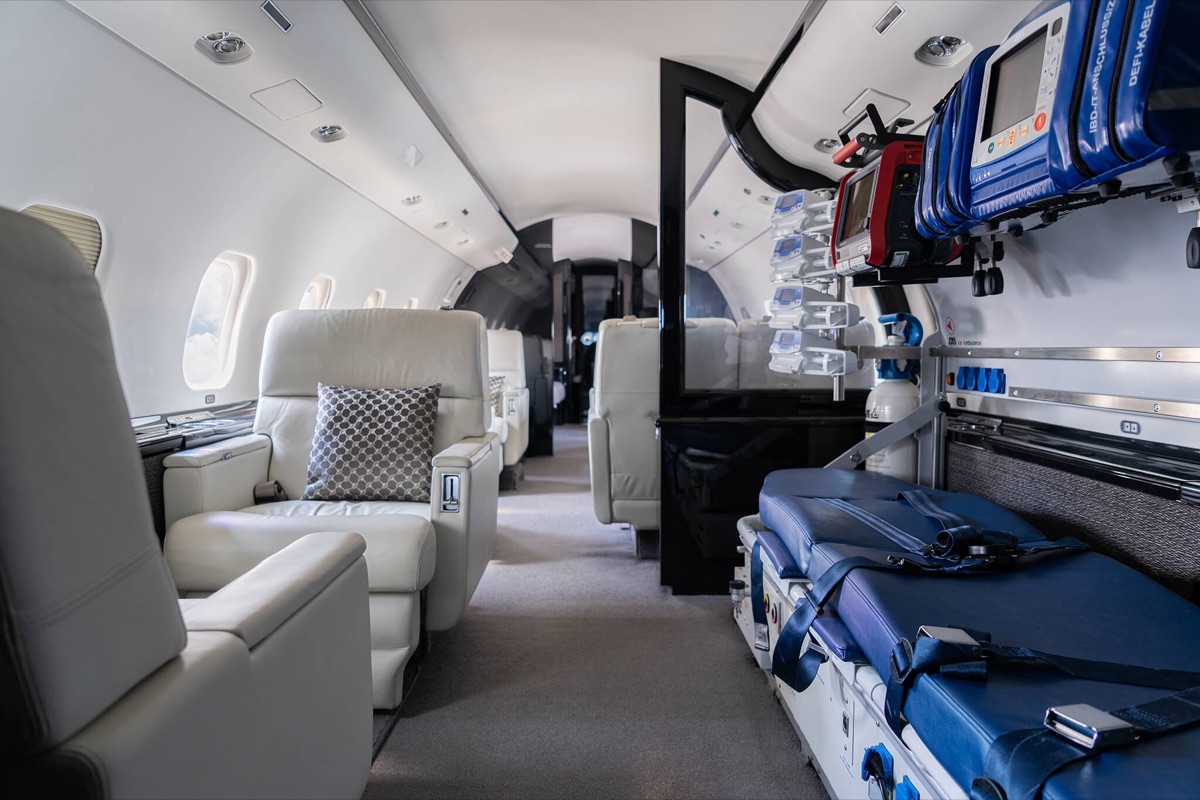
An air ambulance is defined by its equipment and crew, not by the aircraft type. A correctly equipped aircraft carries everything an intensive care unit carries, in a form that survives pressure changes and turbulence.
Medical equipment
Transport ventilator, multi-parameter monitoring with ECG, oxygen saturation, blood pressure and capnography, syringe and infusion pumps, defibrillator, suction, and oxygen sized for the full flight plus a legal reserve. Medication is carried for the expected course as well as for foreseeable complications.
The crew
Sized to the condition. A stable patient may travel with a flight nurse; an intensive care patient travels with a doctor and a nurse, and where the situation calls for it a specialist such as a neonatologist or a perfusionist joins.
The aircraft
A pressurised cabin that can hold a low cabin altitude matters more than speed. For patients with head injury, severe anaemia or decompression illness, the permissible cabin altitude is itself part of the medical plan.
How fast can it actually go
For a confirmed urgent case, departure within a few hours is normal. But the aircraft is rarely the constraint. In practice the clock is set by three things: medical clearance from the treating hospital, a receiving bed that has formally accepted the patient, and permits and slots for the countries involved.
That is why the first thing we do is speak to the treating physician directly. A transfer that waits on paperwork is a transfer that has not really been arranged.

What an air ambulance costs
Cost tracks distance, aircraft size and crew, roughly in that order. Each fuel stop on a long route adds landing fees, handling and a permit, so the price steps up rather than rising smoothly with distance.
Because the variables are specific to the patient and the route, we give a fixed total for your situation rather than a bracket that will not fit it. That takes about an hour once we have spoken to the treating physician.
If a dedicated aircraft turns out to be beyond what you can arrange, say so early. A medical escort on a scheduled flight often achieves the same clinical outcome for a fraction of the price, and we would rather tell you that than sell you an aircraft. See what drives the cost.
What happens in the hours before departure
Families are often surprised that the aircraft is ready long before the transfer is. Four things run in parallel from the moment we are contacted, and the slowest one sets the departure time.
The clinical conversation
Our doctor speaks to the treating physician. Not to ask permission, but to understand the picture: what is running, what the trend has been over the last twelve hours, what the risks are at altitude. That conversation decides the crew, the equipment and sometimes the aircraft type.
The receiving bed
A hospital at the destination has to formally accept the patient, by name, with a consultant who takes responsibility. This is frequently the slowest step, particularly for specialist units where beds are scarce, and it is entirely outside a transport provider's control.
Permits and slots
Overflight and landing permission for every country on the route, plus an airport slot at both ends. Most are routine and quick. A few regions take hours or require documentation that has to be produced first.
Ground transport at both ends
An ambulance at the departure hospital and another at the destination, timed to the flight. A late ground ambulance costs the same as a late aircraft, so both are booked by the same coordinator.
Questions to ask before you commit
Air ambulance is a field where it is hard to judge quality from the outside, and where the person deciding is usually exhausted and frightened. These questions are quick, and the answers tell you a great deal.
- Have you spoken to the treating physician? If not, every other answer is provisional.
- Who exactly is on board? Names and disciplines, not "a medical team".
- Is a receiving bed confirmed, and by whom? Ask for the accepting consultant's name.
- Is the price the total, bed to bed? Ground ambulances, permits, handling and crew should all be inside it.
- What happens if the patient deteriorates before departure? Deterioration is common, and the financial answer should be clear in advance.
- Are you the operator, or arranging it through someone else? Both can work, but you should know which.
Which aircraft, and why it matters medically
Aircraft choice is usually presented as a question of range and budget. Clinically, three other properties matter more, and they are worth understanding because they explain why a provider may propose something other than the cheapest available airframe.
Cabin pressure
A pressurised cabin does not mean sea level. Most aircraft hold a cabin altitude somewhere between 1,500 and 2,400 metres at cruise, which means less available oxygen and any trapped gas expanding by a fifth or more. For a patient with a head injury, severe anaemia, a recent abdominal operation, a pneumothorax or decompression illness, that is clinically significant. Some aircraft can fly lower or hold a lower cabin altitude at the cost of range and fuel. When that is required it is a medical specification, not an upgrade.
Cabin size and access
An intensive care team needs to reach the patient from both sides, swing a ventilator circuit, and perform an intervention in flight without disassembling the installation. A cabin that technically fits a stretcher is not the same as a cabin a team can work in. This is why a larger aircraft is sometimes proposed for a short flight.
Door and loading geometry
The stretcher has to get in. On smaller types the door aperture and the angle of the entry determine whether a patient can be loaded lying flat, or whether they must be tilted, which is unacceptable for some conditions. It is an unglamorous constraint that quietly rules out aircraft on certain cases.
Where air ambulance ends and other options begin
Being clear about what an air ambulance is not, is as useful as knowing what it is.
It is not a rescue helicopter. Scene response, hoisting from a mountainside or a ship, and landing at the roadside are the work of helicopter emergency medical services, usually publicly funded and dispatched by the local emergency system. An air ambulance is a fixed-wing aircraft doing planned hospital-to-hospital work.
It is not a substitute for local treatment. If the patient needs an operation now and the local hospital can do it, they should have it there. Moving an unstable patient to a hospital you prefer is not a clinical improvement; it is a risk taken for a non-clinical reason. A good provider will say this out loud.
It is not always faster. Within a continent, a long-distance road ambulance frequently wins door to door once you count airport handling at both ends, the wait for a slot, and two extra transfers between vehicles. Fewer handovers also means fewer opportunities for something to go wrong.
See medical flight transport for how the formats compare, and what drives the cost for the economics behind the choice.
How it works
Call or send the request
The patient's location, destination and condition. Even partial information is enough to start.
Medical assessment
Our doctor speaks with the treating physician to establish whether an air ambulance is genuinely indicated.
Plan and fixed price
Aircraft, crew, routing, timing and total cost, usually within the hour.
Clearances and logistics
Permits, slots, ground ambulances and the receiving hospital, arranged in parallel.
Transfer
The team collects the patient at the bedside and hands over at the destination bedside.
Questions fréquemment posées
An aircraft can be ready in hours
Tell us where the patient is and where they need to be. Our medical team calls the treating hospital and comes back with a plan and a fixed price.