
international air ambulance
International air ambulance: moving patients between continents
Last reviewed
Un devis gratuit en 3 étapes
Vous pouvez être assuré que notre prix est basé sur le marché et qu'il nous permet de fournir les meilleurs soins possibles.

Ambulance aérienne

Escorte médicale

Ambulance routière
Range decides the number of fuel stops, and each stop is a country that must issue a permit.
- Longest routine sectors
- Intercontinental, with fuel stops
- Crew
- ICU team, doubled where required
- Permits
- Arranged by us
- Pricing
- Fixed total, all-in
What makes an intercontinental transfer different
On a short regional flight the aircraft leaves and arrives. On a long-haul medical transfer, four things change the plan.
Fuel stops
Few medical aircraft cross an ocean without stopping. Each stop adds ground time, and each stop is a country that must issue a permit. The stops are chosen for handling quality and medical backup as much as for range.
Crew duty limits
Flight crew are bound by duty time regulations. A transfer that exceeds them needs a second crew positioned along the route, or a rest stop. Medical crew fatigue matters just as much and is planned for explicitly.
Cabin altitude
On a long flight the cumulative effect of cabin pressure is significant for patients with head injuries, severe anaemia or recent surgery. The permitted cabin altitude becomes part of the medical plan and can dictate the aircraft type and the routing.
Documentation
Passports, visas where required for crew and patient, customs and immigration at each technical stop, and the medical record that travels with the patient. Missing paperwork grounds transfers more often than weather does.
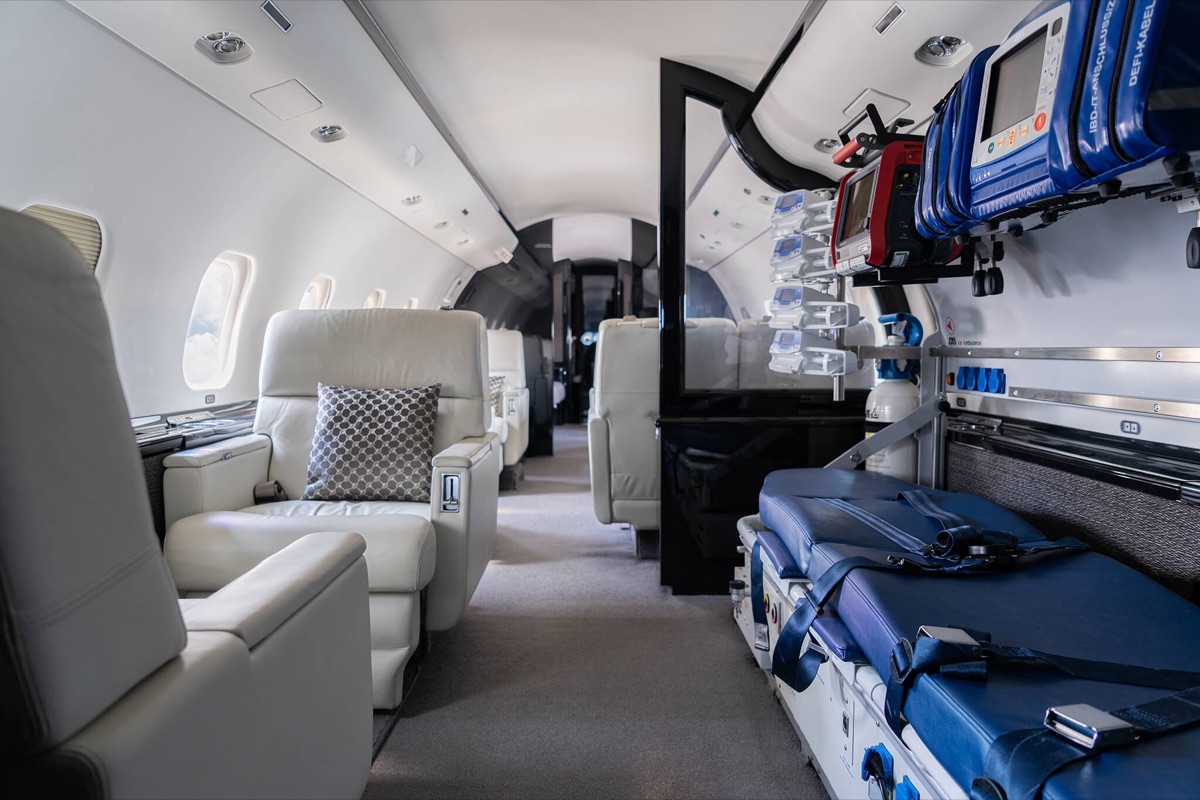
Routes we fly regularly
These are real completed transfers, which gives a sense of the distances and the operational complexity involved.
| Route | Type | Fuel stops |
|---|---|---|
| Beirut to Toronto | Air ambulance | Two |
| Rome to Toronto | Air ambulance | One |
| Kahului, Hawaii to Scottsdale, Arizona | Air ambulance | Direct |
| Bridgetown, Barbados to Toronto | Air ambulance | Direct |
| Alexandria to Fredericton, Canada | Air ambulance | Two |
| Playa del Carmen to New York | Air ambulance | Direct |
For insurers, assistance companies and employers
If you are arranging this on behalf of a member, policyholder or employee rather than for your own family, the priorities are different. What matters is a defensible decision, a predictable cost and a clean handover.
- A medical recommendation, not a sales pitch. Where an escorted airline flight is clinically adequate we will say so, even though it is the smaller invoice.
- One fixed price for the whole chain, including ground ambulances, permits, handling and crew. No supplementary invoices after the fact.
- Direct contact with the treating and receiving physicians, so the clinical decision rests on a conversation rather than a form.
- A written medical record of the journey, handed over at the receiving bedside.
- One point of contact throughout, reachable at any hour.
What drives the cost
Four variables account for nearly all of the difference between one intercontinental transfer and another:
Distance and fuel stops. Each stop adds handling, fees and hours. Aircraft type. Range and cabin size, which follow from the distance and the medical configuration. Medical crew. A flight nurse, a doctor and nurse, or a full intensive-care team with a specialist. Permits and handling at each country on the route, which vary enormously by region.
Where an intercontinental air ambulance is out of scope, a stretcher or escorted airline transfer covers the same distance for a fraction of the cost, provided the patient is stable enough.
How it works
Request
Origin, destination, and the clinical summary or the treating physician's contact details.
Medical review
Fitness to fly, cabin altitude requirements and the crew the condition calls for.
Operational plan
Routing, fuel stops, permits and crew rotation, with a fixed total price.
Clearances and beds
Permits filed, receiving hospital confirmed, ground ambulances booked at both ends.
Transfer and handover
Bed to bed, with a written medical record and a verbal handover to the receiving team.
Questions fréquemment posées
Related services
Intercontinental transfers, arranged end to end
Send us the origin, the destination and the clinical picture. You get a routing, a crew plan and a fixed total price, usually within the hour.