Medical transportation services near me for elderly: what they are, how they work, and who to call
Medical transportation services near me for elderly are specialized transport operations that move older patients safely between hospitals, care facilities, or across international borders, with certified medical staff present throughout the journey. For families managing a parent or grandparent's care after a stroke, fall, or chronic illness episode, finding the right service quickly can prevent a routine transfer from becoming a medical emergency.
The term covers several distinct service types, from road ambulances for short local transfers to full air ambulance operations spanning multiple continents. At EMS, we operate across 136+ countries with 50+ certified medical professionals, providing bed-to-bed care that starts the moment we receive your call and ends only when your loved one is safely settled at their destination. Not every provider offers this level of continuity, and that gap is where serious complications tend to arise.
Why elderly patients have unique transport needs
Elderly patients face compounding risks during transport that younger patients rarely encounter. Approximately 30% of adults over 65 experience at least one fall per year, and those recently hospitalized carry a significantly elevated risk of deterioration during any transfer. Specialized elderly medical transport is not optional in these cases; it is medically necessary.
Several factors make elderly transport different from standard patient transfer:
- Polypharmacy complexity: Many elderly patients take five or more medications simultaneously, requiring a medic on board who can monitor for interactions during transit.
- Cardiovascular fragility: Cabin pressure changes during air transport can stress an already compromised cardiovascular system, so pre-flight assessment is critical.
- Cognitive sensitivity: Patients with dementia or delirium can become acutely agitated in unfamiliar environments. A trained medical escort provides both clinical monitoring and emotional continuity.
- Pressure injury risk: Long transport times without repositioning can cause rapid skin breakdown in immobile elderly patients. Proper stretcher setup and scheduled repositioning prevent this.
Families who choose a non-medical transport provider to cut costs often experience a secondary hospitalization within 48 hours of the transfer. Data from elderly transport audits shows that 60% of complications from unsuitable transport occur within two days of arrival, compared to less than 8% when appropriate medical accompaniment is provided. That outcome costs far more than the original service in money, stress, and medical risk.
Types of medical transportation services available for elderly patients
The right service type depends on the patient's clinical condition, the distance involved, and how urgently they need to move. Here is a direct comparison of the main options:
| Service type | Best suited for | Medical support level | Typical use case |
|---|---|---|---|
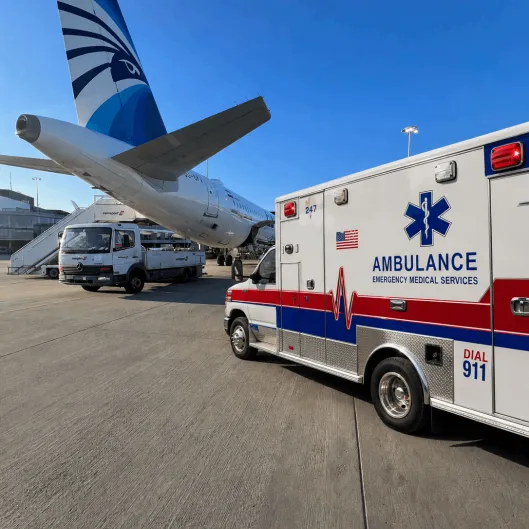
| Road ambulance | Local or regional transfer | EMT or paramedic | Hospital to care home, same city |
| Medical escort | Stable patients on commercial flights | Nurse or doctor accompaniment | Returning home from abroad after illness |
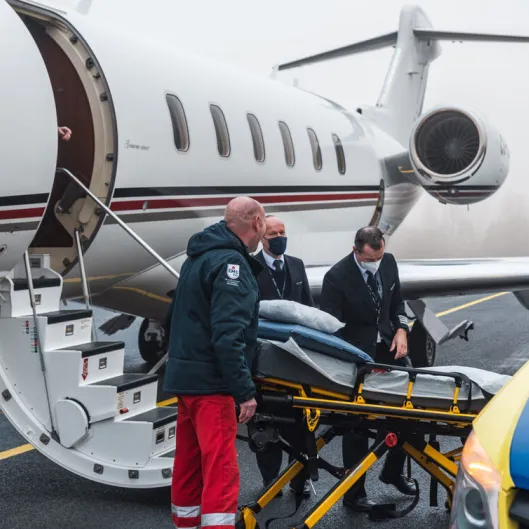
| Air ambulance | Critical or complex cases over long distances | Full ICU-level onboard team | Stroke patient repatriation across continents |
| Private medical jet | Patients requiring maximum privacy and speed | Physician plus specialist nurse | Time-sensitive transfers, VIP patients |
Choosing the wrong tier is a common and costly mistake. A stable elderly patient with controlled diabetes who needs to fly home from Spain does not need a full air ambulance. A medical escort on a commercial flight is clinically appropriate, significantly cheaper, and often faster to arrange. A patient recovering from a hip fracture with post-operative complications, on the other hand, needs the dedicated medical environment of an air ambulance, not a standard flight with a companion.
How to find and evaluate medical transportation services near you for an elderly relative
When you search for medical transportation services near me for elderly, the results can be overwhelming. This framework helps you evaluate any provider quickly:
- Confirm certification: Ask whether the company holds ISO 9001 or equivalent quality certification. EMS holds TUV ISO 9001 certification, which requires documented clinical protocols, regular audits, and measurable quality standards.
- Ask for a quotation timeframe: Reputable providers give a clear, all-inclusive quote within 30 minutes. Vague pricing with hidden extras is a warning sign.
- Verify medical staffing: Confirm the seniority and credentials of the staff assigned to your patient, not just the general team size.
- Check 24/7 availability: Medical situations don't follow business hours. Your provider must be reachable around the clock, including for in-transit emergencies.
- Assess bed-to-bed capability: True bed-to-bed service means the provider handles coordination at both ends, not just the flight or drive segment in the middle.
EMS provides a free quotation in under 30 minutes and operates with 24/7 availability across all 136+ countries we serve. Our 4.5-star rating from families globally reflects both clinical outcomes and the communication and support we provide during what is almost always a very stressful time.
International medical transportation for elderly patients abroad
A growing number of elderly patients fall ill or deteriorate while traveling or living abroad. In those cases, local medical transportation services near you are not enough. You need an international repatriation provider who can coordinate with foreign hospitals, navigate local regulations, and manage the full transfer chain from a foreign ICU to a home hospital bed.
Medical repatriation is the process of transferring a patient from a foreign country back to their home country for continued care, involving careful pre-transfer medical assessment, coordination between two healthcare systems, and continuous monitoring during transit. For elderly patients specifically, understanding what medical repatriation means and when you need it is worth knowing before a crisis occurs. EMS handles all of this, including aftercare coordination on arrival.
Air pressure in commercial aircraft cabins is equivalent to an altitude of roughly 6,000 to 8,000 feet. For an elderly patient with heart failure or chronic respiratory disease, this can trigger acute decompensation. Medical escorts and air ambulance teams trained in elderly care account for this during the initial assessment, not as an afterthought at the boarding gate. Learn more about how air ambulance services work before arranging transport for a clearer picture of what to expect.
Frequently asked questions about medical transportation services for elderly
What is the difference between a medical escort and an air ambulance for elderly patients?
A medical escort is a qualified nurse or doctor who accompanies a stable elderly patient on a regular commercial flight, monitoring their condition throughout the journey. An air ambulance is a dedicated aircraft configured as a flying ICU, used for patients too unstable to travel commercially. Medical escorts cost 70-85% less than air ambulances and are suitable for patients with stable vital signs and no need for continuous ICU-level intervention during flight.
How quickly can medical transportation services be arranged for an elderly person in hospital abroad?
EMS can provide a full quotation within 30 minutes of your initial contact and mobilize a medical escort or air ambulance within 24 to 48 hours in most cases. Timeframe depends on the patient's stability, destination logistics, and documentation required by foreign authorities. We coordinate all requirements on your behalf, so families don't manage airline, hospital, and customs logistics independently.
Is medical transportation for elderly patients covered by travel insurance?
Many travel insurance policies include medical repatriation cover, but specifics vary considerably. Some cover only air ambulance costs up to a set limit; others exclude pre-existing conditions, which affects many elderly travelers. Review your policy's medical evacuation clause before travel. If transport is needed, contact your insurer and a provider simultaneously so coverage and transport can be arranged without delay.
What medical equipment is available during elderly patient transport?
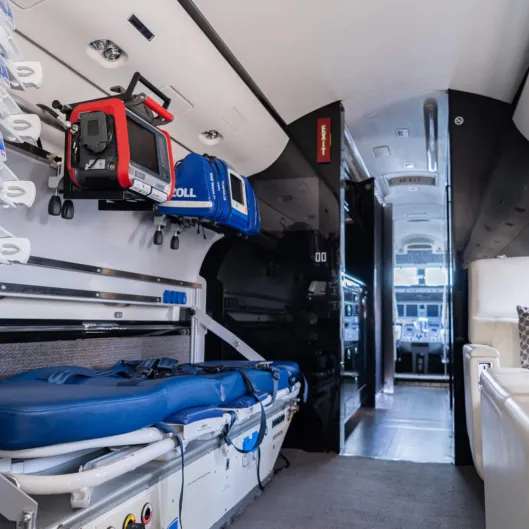
EMS air ambulances carry full ICU-level equipment, including cardiac monitors, ventilators, defibrillators, infusion pumps, and emergency medication kits. Road ambulances and medical escorts carry equipment scaled to the patient's specific needs, confirmed during pre-transport clinical assessment. For elderly patients with specific requirements, such as oxygen dependency or post-surgical drain management, transport setup is configured to address those needs directly.
Can EMS transport an elderly patient with dementia or cognitive impairment?
Yes. EMS transports elderly patients with dementia regularly, and medical teams are trained in managing agitation, disorientation, and behavioral changes in transit. Familiarity, calm communication, and careful sedation management when clinically appropriate are all part of the approach to these transfers. We also brief families on what to expect during the journey, so there are no surprises at either end.
The right care gets your loved one home safely
Searching for medical transportation services near me for elderly is often the first step families take in a moment of fear and uncertainty. Service quality varies enormously across providers, and the wrong choice carries real clinical risk for an elderly patient. What distinguishes a trustworthy provider is transparent pricing, certified staff, bed-to-bed coordination, and genuine 24/7 availability — not just a professional-looking website. Ask direct questions about staffing credentials and response times before committing to any service.
At EMS, we bring your loved one home with the right clinical care. No matter where they are, we transport them safely, with a certified medical team, all-inclusive pricing, and a free quote in under 30 minutes. When every hour matters, that response time is exactly what families need.
Need medical transport?
Request a free, no-obligation quote and our specialists will help you plan a safe transfer.
Related blogs