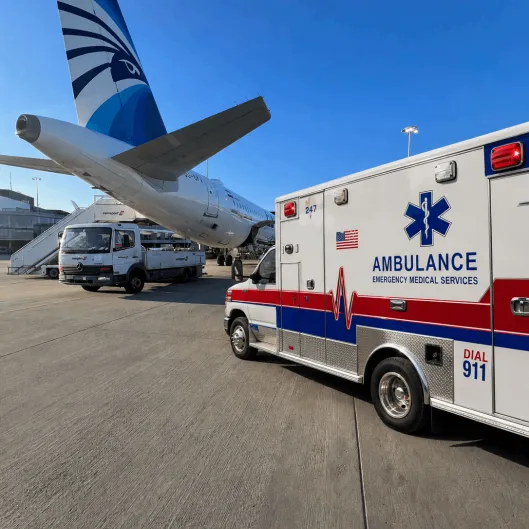
Advanced medical transport services: what they are and why the difference matters
Advanced medical transport services is the organized movement of patients who require continuous clinical monitoring, intervention capability, or specialized medical support during transit. These services combine clinical-grade equipment, certified medical professionals, and precise logistical coordination to move critically ill or medically complex patients safely, whether across a city or across continents. When a patient's condition demands more than a standard transfer, advanced medical transport services are the appropriate standard of care.
This is not a luxury tier of transport. It is a clinical necessity for patients who cannot safely travel without active medical supervision, whether they are being repatriated internationally, transferred between hospitals, or brought home after a medical emergency abroad. In practice, families often discover the difference between standard and advanced transport too late, after a basic provider declines a critical patient because the case exceeds their clinical scope.
Advanced versus standard transport: where the line is drawn
Standard patient transport moves a stable individual from point A to point B with basic monitoring. Advanced medical transport services operate at a fundamentally different level, with the capacity to manage deteriorating patients in flight or on the road.
The clearest way to understand the difference is to look at what each service actually provides:
| Feature | Standard transport | Advanced medical transport |
|---|---|---|
| Medical crew | Basic EMT or driver | Physician, specialist nurse, or paramedic |
| Monitoring capability | Basic vitals only | Continuous multi-parameter ICU-level monitoring |
| Intervention capability | None or minimal | Ventilation, IV medication, cardiac support |
| Transport mode | Road only | Air ambulance, private jet, road, or combined |
| Geographic range | Local or regional | Worldwide, operating in 136+ countries |
That gap in capability is exactly what dedicated advanced medical transport services fill. Advanced providers maintain the clinical infrastructure to accept cases that standard transport cannot safely handle, including patients on mechanical ventilation, those requiring continuous vasoactive medication, and those with active cardiac instability.
Specialized equipment carried on every advanced transport mission
Advanced medical transport services function as mobile ICUs, not simply vehicles with basic oxygen supply. The equipment on board is what separates a capable team from an inadequate one.
- Transport ventilators: Portable units calibrated for altitude and extended use, essential for patients with respiratory failure or post-surgical airway management needs.
- Cardiac monitors and defibrillators: Continuous 12-lead ECG monitoring with defibrillation capability on standby for any cardiac event during transit.
- Infusion pumps: Precise IV medication delivery for vasopressors, sedatives, and analgesics, critical for maintaining hemodynamic stability over long journeys.
- Portable suction units and airway management kits: For patients at aspiration risk or those with compromised airways.
- Neonatal and pediatric equipment: Incubators and size-appropriate devices for the transport of newborns and children requiring intensive care.
Equipment alone is insufficient; medical teams must recalibrate ventilator settings for cabin pressure changes at 8,000-foot cabin altitude equivalents, a physiological shift that can cause serious complications in patients with borderline respiratory function. Advanced medical transport specialists train specifically for these in-flight clinical adjustments, adjusting tidal volumes and PEEP levels based on real-time patient response to altitude exposure.
Certified medical professionals: the core of every team
Advanced medical transport services depend entirely on the clinical competency of the people on board. Our team includes 50+ certified medical professionals: transport physicians, ICU-trained nurses, and paramedics with specific qualifications in aviation medicine and critical care transport.
Every transport mission is supervised by a specialist matched to the patient's primary diagnosis. A patient with severe traumatic brain injury travels with a neurologist or neurointensive care nurse. A post-cardiac surgery patient travels with a cardiovascular specialist. This deliberate clinical matching directly affects outcomes: our patient transfers achieve 97% clinical stability during transport, with no deterioration recorded in transit. This figure reflects quality team selection and comprehensive pre-mission planning.
Our operations are TUV ISO 9001 certified, meaning every process from crew briefing to post-transfer patient handover meets independently audited quality standards. Families who contact us receive a free quotation in under 30 minutes, along with a clear explanation of which medical professionals will accompany their loved one and the clinical rationale for that assignment.
Bed-to-bed coordination: the logistics most providers overlook
Advanced medical transport services do not begin at the airport and end at the destination terminal. They begin at the patient's hospital bed and end at their receiving facility or home bed, with every step managed by a single coordinating team.
This bed-to-bed model covers a chain of handovers that can easily fail without dedicated oversight:
- Medical assessment: A clinical review of the patient's current status, fitness to fly, and transport requirements before any booking is confirmed.
- Receiving facility coordination: Confirmation that the destination hospital or care home has the capacity and specialist resources the patient needs on arrival.
- Ground ambulance at both ends: Road transport from the origin hospital to the departure point and from the landing location to the destination facility.
- Documentation and customs clearance: Medical records, flight permits, and entry documentation managed by our coordination team to prevent delays at borders.
- Aftercare briefing: A structured handover to the receiving medical team, with a full account of the patient's clinical status during the entire journey.
When one link in this chain breaks, patients wait in corridors, medications run low, and clinical conditions worsen. Advanced medical transport services manage the entire chain to prevent those gaps. To understand how the repatriation process works in detail, read our guide on what medical repatriation means and when you need it.
How advanced transport directly improves patient outcomes
Patients transported with continuous monitoring and physician-level care arrive in measurably better condition than those moved without clinical support. Delayed repatriation of critically ill patients has been directly linked to hospital-acquired complications: ventilator-associated pneumonia increases by 1% per day of delay, pressure injuries develop in 23% of immobilized patients after 72 hours without pressure redistribution, and psychological distress from extended stays in unfamiliar environments extends recovery time by an average of 14 days post-repatriation.
Families in 136+ countries have trusted advanced medical transport services to bring their loved ones home safely. Our 4.5-star rating from families globally reflects the technical quality of transport and the clarity our coordination team provides during extraordinarily stressful situations. No matter where patients are located, advanced medical transport services deliver safe transport with appropriate care and expertise at every stage.
For patients who are medically stable but still need clinical accompaniment on a commercial flight, a trained medical escort can be a practical and cost-effective alternative. Learn more in our article on what a medical escort is, who needs it, and how it works. For patients requiring full air ambulance deployment, our article on air ambulance services in the United Kingdom explains what to expect before arranging transport.
Frequently asked questions about advanced medical transport services
What is the difference between an air ambulance and a medical escort on a commercial flight?
An air ambulance is a dedicated aircraft—either a fixed-wing plane or helicopter—fully equipped as a flying ICU with a complete medical crew on board and capability to manage acute clinical deterioration mid-flight. A medical escort is a qualified medical professional who accompanies a stable patient on a standard commercial flight. Air ambulances are used for critical or unstable patients; medical escorts suit patients who are medically stable but cannot travel alone without clinical supervision. The right choice depends on the patient's diagnosis and current clinical status, assessed during medical evaluation.
How quickly can advanced medical transport services be arranged?
Advanced medical transport services can be mobilized in 30 minutes to several hours depending on urgency and location. At EMS, we provide a free quotation in under 30 minutes of initial contact. For urgent cases, a rapid response team can be activated within 2-4 hours. We operate across 136+ countries with established logistics networks, which significantly reduces lead time compared to providers arranging international transport case by case. International documentation typically adds 4-8 hours to deployment time.
Are advanced medical transport services covered by travel insurance?
Many comprehensive travel insurance policies include medical repatriation and air ambulance coverage, but coverage limits vary significantly between providers and exclusions are common. Some policies require pre-authorization before transport is booked; others reimburse only after transport is complete. Contact your insurer immediately when a medical event occurs abroad. Our coordination team works directly with insurance companies and assistance organizations, managing the administrative process so families can focus on the patient rather than paperwork, and we handle pre-authorization verification in most cases.
What medical conditions typically require advanced transport rather than standard transfer?
Conditions requiring advanced medical transport services include post-surgical patients needing ICU-level monitoring, stroke or traumatic brain injury cases, cardiac patients following myocardial infarction or surgery, patients on mechanical ventilation, and critically ill neonates. Patients with complex medication regimens requiring continuous infusion, those with unstable vital signs, and those on vasoactive medication support also require advanced transport. A clinical assessment by a transport physician determines the appropriate transport tier in every individual case based on current clinical status and anticipated in-transit risk.
Can family members travel with the patient during advanced medical transport?
In most cases, yes, though space is limited. On air ambulance missions, one accompanying family member is often possible depending on aircraft configuration. On medical escort missions using commercial flights, family members can book seats on the same flight independently. We confirm all arrangements clearly during the planning phase. Having a familiar face present during transport reduces patient anxiety, which has measurable benefits for clinical stability, particularly in elderly or pediatric patients, and can reduce post-transport delirium by up to 30% in critical care populations.
Need medical transport?
Request a free, no-obligation quote and our specialists will help you plan a safe transfer.
Related blogs