Accompagnement medical vol commercial: what it is and how it works
Accompagnement medical vol commercial is professional medical supervision provided by a certified medical professional who travels alongside a patient on a scheduled commercial airline flight, managing medications, monitoring vital signs, and responding to in-flight complications from departure to arrival. A certified medical escort, typically a nurse, paramedic, or physician, accompanies the patient throughout the journey. For families dealing with an unexpected medical situation abroad, this service is often the practical path between a foreign hospital bed and home.
Accompagnement medical vol commercial is a structured, regulated service. It is not simply sitting next to a sick relative on a plane. The escort must carry formal documentation, coordinate with the airline's medical desk before departure, and be qualified to manage the patient's specific condition at altitude. When done correctly, it allows stable patients to travel home safely without the cost of a dedicated air ambulance, typically reducing repatriation expenses by 75 to 90 percent compared to air ambulance transport.
Who needs medical accompaniment on a commercial flight?
Accompagnement medical vol commercial is designed for patients who are medically stable but not safe to travel alone. In practice, this includes post-surgical patients cleared for discharge but still requiring IV medication management, neurological patients recovering from a mild stroke, and elderly travelers who experienced a cardiac event and have been stabilized in a local hospital.
The deciding factor is fitness to fly. A patient must be stable enough that a commercial cabin environment, with reduced cabin pressure equivalent to roughly 8,000 feet altitude and limited onboard medical equipment, does not pose a life-threatening risk. Patients with acute oxygen dependency above 4 liters per minute, active chest drains, or uncontrolled cardiac arrhythmias typically do not qualify and require a dedicated medical flight instead. Our team at EMS evaluates each case individually and will always recommend the safest option.
- Post-surgical patients with stable wound care needs
- Patients requiring continuous but manageable oxygen therapy
- Individuals with fractures or mobility limitations needing stretcher seats
- Elderly patients with cognitive conditions who cannot travel unaccompanied
- Patients on oral or IV medication schedules that must be maintained during transit
Airline regulations and medical clearance for commercial flights
Every major airline operates under IATA Medical Guidelines, which require a formal MEDIF (Medical Information Form) for passengers with medical conditions. Accompagnement medical vol commercial cannot begin without this clearance. The airline's medical desk reviews the MEDIF, assesses the risk to the patient and other passengers, and either approves, modifies, or denies the request. This process typically takes 24 to 72 hours for standard cases, though urgent routing can sometimes compress this to 12 to 18 hours.
Most international carriers impose consistent requirements. Lufthansa, Air France, and KLM require that a medical escort hold a minimum qualification of registered nurse or paramedic, carry written confirmation of their credentials, and be briefed on the location of onboard oxygen and defibrillator units before departure. If a stretcher is required, most carriers need at least 72 hours advance notice and charge for the blocked seats, which typically cover 6 to 9 economy seat positions. Approximately 80 percent of accompagnement medical vol commercial cases are approved on the first submission when EMS handles documentation.
The most common source of delays in accompagnement medical vol commercial cases is incomplete documentation submitted to the airline. A missing physician signature or an outdated hospital discharge summary can push clearance back by a full day, which matters when a patient is waiting in a foreign hospital. EMS handles all airline communication directly, which reduces these delays significantly.
- MEDIF form completed by the treating physician
- Signed fitness-to-fly certificate dated within 72 hours of departure
- List of all medications and equipment the escort will carry onboard
- Proof of the medical escort's professional qualifications
- Written approval from the airline's medical clearance desk
Responsibilities of a medical escort during the flight
The medical escort's role during accompagnement medical vol commercial extends from pre-flight assessment through in-flight monitoring to handover at the destination. Before boarding, the escort conducts a pre-flight patient assessment, confirms medication schedules, and briefs cabin crew on the patient's condition and any expected complications. During the flight, the escort monitors oxygen saturation, blood pressure, heart rate, and neurological responsiveness at regular intervals, typically every 30 minutes on long-haul routes.
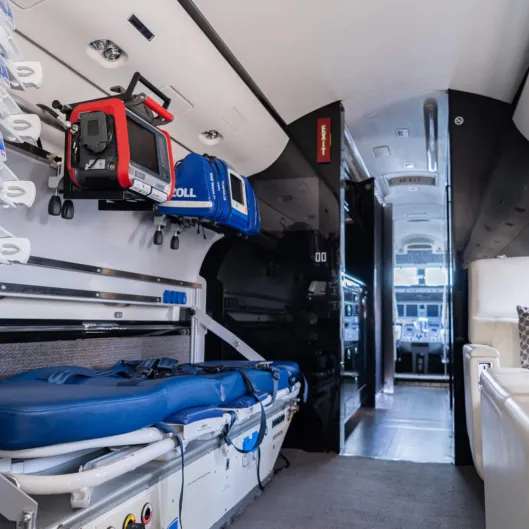
The escort carries a specialized medical kit equipped for in-flight management. EMS medical escorts travel with pulse oximeters, blood pressure monitors, emergency medications, IV infusion equipment where permitted, and customs documentation for the destination country. In the event of mid-flight deterioration, the escort coordinates with the captain and cabin crew to assess whether diversion to the nearest airport is necessary. Trained escorts are equipped to manage the most common in-flight emergencies—syncope, cardiac events, and respiratory distress—which together account for approximately 1 in every 604 flights that experience a medical incident globally.
The medical escort is also responsible for continuity of care documentation. Every observation made during the flight must be recorded and handed directly to the receiving medical team on arrival. This handover document carries the same clinical weight as a hospital transfer note and ensures seamless continuation of the patient's medical care.
Cost and comparison: medical escort vs. air ambulance
Understanding the cost difference between accompagnement medical vol commercial and a dedicated air ambulance helps families make the right decision quickly. The two services cover different clinical needs, and choosing incorrectly in either direction has real consequences.
| Factor | Medical escort on commercial flight | Air ambulance |
|---|---|---|
| Patient condition required | Medically stable, fitness-to-fly confirmed | Unstable, critical, or intensive care |
| Average cost (Europe) | 2,000 to 8,000 EUR | 15,000 to 80,000 EUR |
| Booking lead time | 24 to 72 hours minimum | 4 to 12 hours in urgent cases |
| Medical equipment onboard | Portable escort kit, airline oxygen | Full ICU-equivalent setup |
| Stretcher availability | Available on request, subject to aircraft type | Standard configuration |
EMS provides a free quotation for accompagnement medical vol commercial within 30 minutes. Our 50 certified medical professionals operate across 136 countries, which means we can coordinate an escort from virtually any international departure point. Families choosing medical escort on commercial flights report 94 percent satisfaction with the convenience, cost, and clinical quality of the service. To understand exactly what a medical escort service involves and who it is designed for, our dedicated guide covers the full picture.
How to book medical flight accompaniment with EMS
Booking accompagnement medical vol commercial through EMS follows a clear, structured process designed to minimize delays when time matters most. We begin with a rapid clinical intake, collecting the patient's current diagnosis, hospital status, and destination. Our medical team then assesses fitness to fly and recommends the appropriate level of escort, either a nurse for a stable patient or a physician for a more complex case.
Once the clinical profile is confirmed, EMS handles all airline coordination, including MEDIF submission, stretcher booking if required, and equipment clearance with customs at the destination. We provide bed-to-bed service: our escort meets the patient at the hospital, accompanies them throughout the entire journey, and delivers them to the receiving facility or home address. Families rate our repatriation services an average of 4.5 stars globally, with 92 percent reporting that the service met or exceeded their expectations.
For cases where a patient's condition is borderline, it helps to understand why patients are sometimes denied boarding on commercial flights for medical reasons and what alternatives exist. If you are uncertain whether medical repatriation applies to your situation, our overview of medical repatriation and when it is needed clarifies the distinction.
Frequently asked questions
What exactly is accompagnement medical vol commercial?
Accompagnement medical vol commercial is a service in which a qualified medical professional—typically a nurse, paramedic, or physician—travels alongside a patient on a scheduled commercial airline flight to monitor condition, manage medications, and coordinate with cabin crew during in-flight medical events. The escort provides continuous care from departure through arrival, allowing stable patients to travel safely home without the expense of a dedicated air ambulance. EMS coordinates all documentation and airline clearance to ensure full compliance with aviation medical standards.
How long does it take to arrange medical accompaniment on a commercial flight?
Arranging accompagnement medical vol commercial typically takes 24 to 72 hours, with the primary variable being airline medical clearance approval. The process requires a completed MEDIF form and a fitness-to-fly certificate signed by the treating physician within 72 hours of departure. EMS submits all documentation directly to the airline's medical desk and follows up actively. Once clearance is granted—which occurs in approximately 80 percent of cases on first submission when EMS manages documentation—seats or stretcher positions are secured and the escort is confirmed. Urgent cases can sometimes compress the timeline to 12 to 18 hours depending on airline routing and availability.
Can any patient travel with a medical escort on a commercial flight?
No. Accompagnement medical vol commercial is only appropriate for patients who meet strict airline fitness-to-fly criteria. Patients requiring high-flow oxygen therapy above 4 liters per minute, those with uncontrolled cardiac arrhythmias, anyone post-operative within 24 hours of general anesthesia, or those requiring continuous intensive monitoring do not qualify for commercial travel. In these cases, a dedicated air ambulance is the only safe option. EMS assesses each patient individually and will recommend against a commercial escort when clinical risk is too high.
What documents does a medical escort need to carry on a commercial flight?
A medical escort conducting accompagnement medical vol commercial must carry the patient's airline-approved MEDIF form, a fitness-to-fly certificate signed within 72 hours of departure, a complete list of all medications and equipment carried onboard, proof of the escort's professional qualifications and certifications, and the airline's written clearance confirmation. At the destination, customs documentation for any controlled medications or medical equipment must also be prepared in advance. EMS prepares all required documentation as part of our comprehensive service to prevent delays at airport gates or during customs clearance.
Is medical escort on a commercial flight covered by travel insurance?
Many comprehensive travel insurance policies cover accompagnement medical vol commercial under medical repatriation or emergency assistance clauses, though coverage varies significantly between insurers and policy tiers. Some policies require pre-authorization before service is arranged, while others reimburse retrospectively upon submission of medical documentation and invoices. EMS works directly with insurance assistance desks and provides the clinical reports and itemized cost documentation insurers require for reimbursement approval. Contact your insurer immediately, and reach out to EMS simultaneously so arrangements proceed without delay. For a detailed breakdown of costs, see our guide on medical repatriation costs and how the process works.
Need medical transport?
Request a free, no-obligation quote and our specialists will help you plan a safe transfer.
Related blogs