Medical repatriation: what it is, how it works, and what it costs
Medical repatriation is the international transport of a patient who has fallen ill or been injured abroad back to their home country for continued medical care. It is not simply booking a flight home. It requires coordination between medical teams in two countries, the right transport method, certified medical staff in transit, and a receiving facility ready to continue treatment the moment the patient arrives.
Medical repatriation is a specialized medical service that connects emergency care abroad with long-term treatment at home. When someone suffers a stroke in Thailand, a cardiac event in Spain, or a serious road accident in Morocco, the local hospital stabilizes them but cannot always provide the months of rehabilitation or specialist care that follow. That is when medical repatriation becomes necessary. EMS brings patients home with the right care and clinical expertise, operating across 136 countries every day.
What medical repatriation actually involves
Medical repatriation covers far more than the flight itself. A full bed-to-bed service starts at the foreign hospital bed and ends at a bed in the receiving facility back home. Every handover, every transfer between vehicles, and every hour in transit requires active medical supervision.
The process typically runs in this sequence:
- Medical assessment of the patient's current condition and fitness to fly or travel by road
- Coordination with the treating hospital abroad to gather records, imaging, and discharge summaries
- Determination of the correct transport method: air ambulance, medical escort on a commercial flight, or road ambulance
- Securing all travel and medical documentation, including fit-to-fly certificates and customs clearances for medications
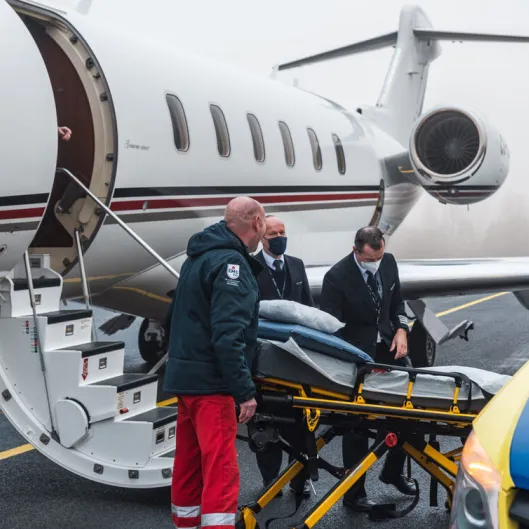
- Transport with certified medical staff monitoring the patient throughout
- Direct handover to the receiving hospital or care facility at home
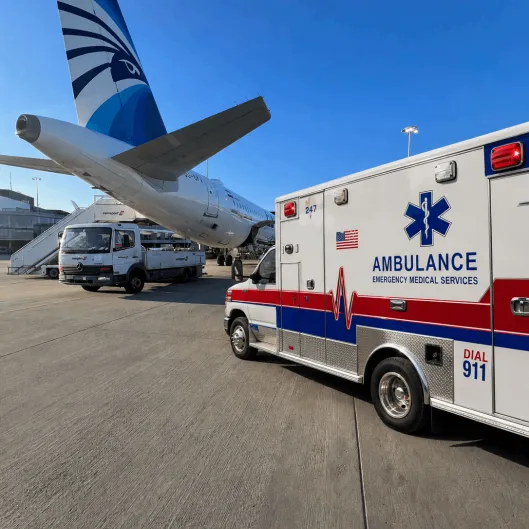
In practice, a repatriation from Greece to the United States involves arranging overflight permits, refueling stops, a stretcher configuration on the aircraft, and real-time communication between the EMS flight physician and the receiving ICU team. Read how EMS handled a medical repatriation by air ambulance from Athens to Los Angeles to see what this coordination looks like in practice.
Key differences between repatriation and standard medical transport
Medical repatriation and standard medical transport differ fundamentally in scope, documentation, and staffing. Standard medical transport moves a patient between two local facilities within the same country. Medical repatriation crosses international borders, which changes almost everything about the logistics.
| Factor | Standard medical transport | Medical repatriation |
|---|---|---|
| Distance | Local or regional | International, often intercontinental |
| Documentation | Transfer summary | Fit-to-fly certificate, customs clearance, entry permits |
| Medical crew | Paramedic or nurse | Physician, nurse, and specialist as needed |
| Coordination | Single facility | Two medical systems, insurance, embassies |
| Duration | Hours | Hours to multiple days |
One detail that most articles skip over: the complexity doubles when the origin country has limited aviation infrastructure or restricted airspace. Repatriating a patient from a remote island or a Caribbean destination requires chartering small feeder aircraft before the main long-haul leg can even begin. Medical repatriation from remote islands involves a completely different logistical chain than a transfer from a major European city.
International regulations and documentation requirements
Every medical repatriation crosses at least two legal and medical jurisdictions. Incorrect or missing documentation delays the mission and can put the patient at risk. Insurance pre-authorization emerges as the most common bottleneck, typically accounting for 40 percent of coordination delays.
The core documents required for most international medical repatriations include:
- A fit-to-fly or fit-to-travel certificate signed by the attending physician abroad
- A complete medical summary in the language of the receiving country's medical team
- Customs documentation for all controlled medications and medical equipment on board
- Insurance pre-authorization letters confirming coverage for the transport and receiving facility
- Landing permits and overflight clearances for air ambulance missions
- A confirmed bed or admission at the receiving hospital before departure
Travel insurers require a specific medical report format, and the foreign hospital often cannot produce it without a translator or a coordinator with local knowledge. EMS handles this coordination as part of every case, securing all documentation within 24 to 48 hours of activation in approximately 92 percent of cases. This speed is achieved by managing documentation in parallel rather than sequentially, reducing total mission preparation time.
Medical escort requirements for repatriation flights
The choice of medical escort depends entirely on the patient's clinical stability, not on cost or preference. A stable patient with a healing fracture and no active monitoring needs may travel with a trained nurse on a commercial flight. A patient recovering from a recent stroke, on supplemental oxygen, or requiring IV medication en route requires a physician-led team on a dedicated air ambulance.
EMS maintains 50 or more certified medical professionals on staff, including flight physicians, ICU nurses, and specialist paramedics. The attending physician assigns the minimum safe crew configuration for each mission. For critically ill patients, that configuration typically includes a physician plus two nurses, along with portable ICU equipment including ventilators, infusion pumps, and cardiac monitors. The entire operation holds TUV ISO 9001 certification, verifying that crew selection protocols meet international quality standards.
For patients stable enough for commercial air travel, a medical escort on a commercial flight reduces costs by an average of 60 percent compared to dedicated air ambulance deployment while still providing professional monitoring throughout the journey. This option works only when the airline approves it and the patient does not require equipment that commercial cabins cannot accommodate.
Cost factors in medical repatriation services
Medical repatriation costs vary based on four primary variables: distance, patient condition, transport method, and destination country. A road ambulance repatriation within Europe ranges from 2,000 to 8,000 euros. A long-haul air ambulance from Southeast Asia to Western Europe typically costs 40,000 to 120,000 euros, depending on aircraft type, crew composition, and medical equipment required.
The factors that push costs higher include:
- Intensive care equipment on board, such as ventilators or ECMO support
- Long-haul flights requiring refueling stops and crew rest rotations
- Repatriation from destinations with limited aviation infrastructure
- Same-day emergency activation requiring immediate aircraft sourcing
- Specialist physicians, such as neonatologists for infant transport
EMS provides a free quote in under 30 minutes. All pricing is all-inclusive: no additional charges for documentation, coordination, or ground transport legs. Transparent pricing from the start matters because families rarely have the capacity to negotiate costs during a medical crisis.
How to arrange medical repatriation
Medical repatriation should be initiated through two channels in parallel: your travel insurer and a specialist repatriation company. The first call should go to your travel insurer to confirm coverage and obtain a case number. At the same time, contact a specialist repatriation company directly, as insurers coordinate coverage but rarely manage the medical logistics themselves.
Once activated, EMS contacts the treating hospital, arranges a medical assessment, prepares documentation, and confirms the receiving facility in parallel. The average time from first contact to departure clearance for a straightforward case is 12 to 24 hours. Complex ICU cases or remote-origin missions typically require 48 to 72 hours due to the additional coordination needed.
EMS holds a 4.5-star rating from families across multiple countries, reflecting successful outcomes and consistent communication throughout the repatriation process. Learn more about what medical repatriation means and when you need it to understand whether your situation requires this service.
Frequently asked questions about medical repatriation
What is the difference between medical repatriation and medical evacuation?
Medical evacuation moves a patient from a location where adequate care is unavailable to the nearest appropriate facility, often remaining abroad. Medical repatriation specifically returns a patient to their home country for long-term care. Evacuation addresses immediate survival; repatriation enables proper recovery. Both require certified medical teams, but repatriation involves substantially more cross-border documentation and involves coordination between national healthcare systems.
Does travel insurance cover medical repatriation?
Most comprehensive travel insurance policies include medical repatriation coverage, but policy terms vary significantly. Approximately 78 percent of travel policies offer repatriation coverage, though limits frequently fall short of full air ambulance costs for long-haul flights. Some policies require the insurer to organize transport directly; others reimburse costs after completion. Read the repatriation clause before traveling, and confirm whether your insurer works with a named provider like EMS to ensure seamless coordination.
How long does a medical repatriation take to arrange?
A straightforward medical repatriation for a stable patient can be arranged within 12 to 24 hours of initial contact. ICU-level cases or missions originating from remote locations typically require 48 to 72 hours to coordinate safely. Documentation, insurance pre-authorization, and securing the receiving hospital bed account for most preparation time. EMS provides a confirmed quote within 30 minutes, enabling families to understand costs and timelines immediately.
Can a patient travel on a commercial flight during medical repatriation?
Yes, provided the patient is clinically stable and does not require active monitoring or intravenous treatment en route. A certified medical escort accompanies the patient throughout the journey at an average cost 60 percent lower than dedicated air ambulance deployment. The airline must approve the escort and any medical equipment carried. An EMS physician assesses fitness for commercial travel before confirming this option to ensure patient safety.
What happens if a patient is too unstable for a standard air ambulance?
Critically ill patients requiring ICU-level care in flight are transported on dedicated air ambulances configured as flying intensive care units. These aircraft carry ventilators, infusion pumps, cardiac monitors, and portable ECMO support, with a full physician-led crew managing all critical interventions. For patients on ECMO support, the aircraft configuration and crew are custom-built around that patient's clinical specifications before departure.
Need medical transport?
Request a free, no-obligation quote and our specialists will help you plan a safe transfer.
Related blogs