Who decides if a patient is fit to fly?
Why families and hospitals trust EMS Air Ambulance
Direct support from a certified, highly experienced medical air transport provider.
- 24/7 immediate availability
- Free quote within 30 minutes
- TÜV ISO 9001:2015 certified
- Experienced doctor and critical care paramedic on every mission
- ICU-equipped aircraft
- Full bed-to-bed service
Who decides if a patient is fit to fly
The decision is strictly medical and made only by qualified healthcare professionals.
Only licensed medical professionals can determine if a patient is fit to fly. At EMS Air Ambulance, this decision is made by our medical team, consisting of an experienced physician and a critical care paramedic. Their assessment ensures that every transport is safe, medically responsible, and aligned with international air medical guidelines.
Whether the patient is stable or critically ill, the decision is always based on objective medical criteria—never on commercial or logistical pressure.

How EMS Air Ambulance performs the medical assessment
Every mission begins with a structured, evidence-based medical evaluation.
How the medical fitness check works
Collect medical documents
Recent reports, vital signs, scans, medication list, and treating physician notes.
Review by EMS physician
A senior doctor analyzes the patient’s stability and care requirements.
Risk analysis
The team checks potential in-flight risks and defines required interventions.
Determine transport type
Air ambulance, medical escort on a commercial flight, or ground ambulance.
Final approval
Transport proceeds only when the medical team confirms it is safe.
Key factors that determine if a patient can fly
Fitness-to-fly depends on clinical stability, required care level, and transport risks.
What EMS checks during fitness-to-fly assessment
- Hemodynamic stability (vital signs and circulation)
- Oxygen needs and respiratory support
- Severity of the current condition or injury
- Required monitoring and interventions
- Risk of deterioration during flight
- Need for ICU-level equipment
- Infection control and isolation needs
- Medication administration during transport
Good to know

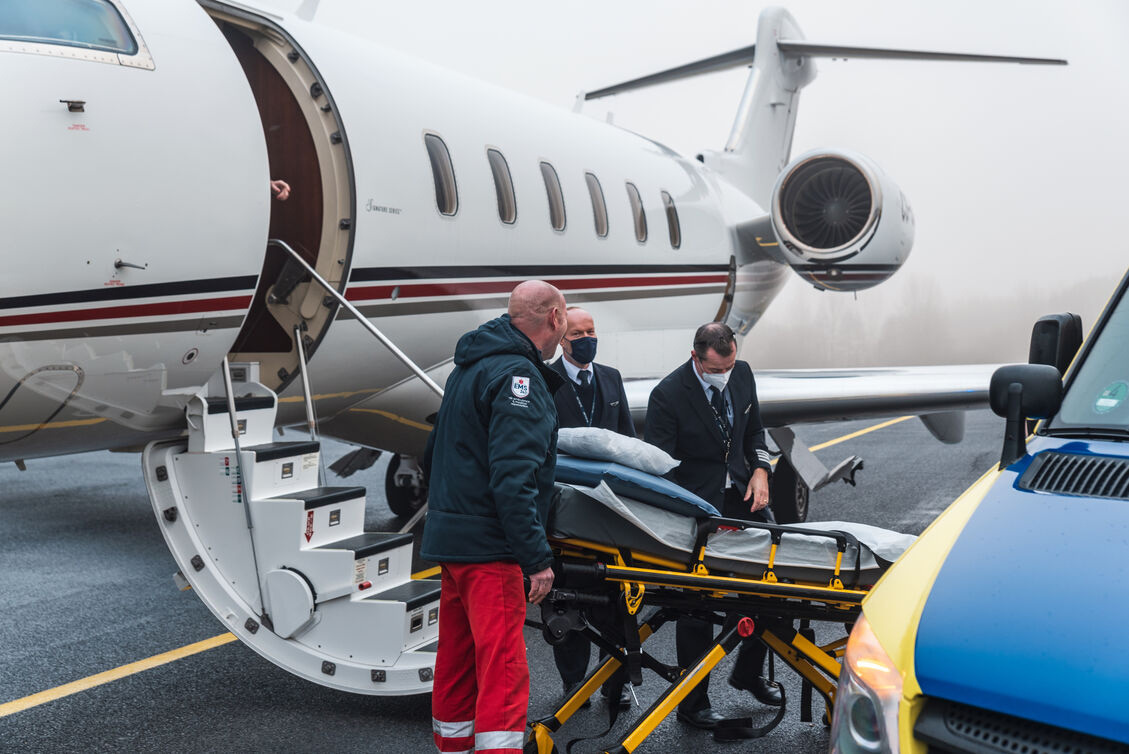
How EMS arranges safe medical transport
From first contact to hospital handover, EMS manages the entire operation.
Full-service process
Immediate response
Available 24/7 with rapid coordination.
Medical and logistical planning
Flight, equipment, crew, ground ambulances, and hospital communication.
Bed-to-bed transfer
Continuous medical supervision from departure to arrival.
Hospital handover
Detailed transfer to the receiving medical team.