Royal ambulance medical repatriation Sri Lanka 2024: what families need to know
Royal ambulance medical repatriation Sri Lanka 2024 is the organized, medically supervised process of transporting a critically ill or injured patient from Sri Lanka back to their home country, using a dedicated medical transport provider operating under international standards. Whether a tourist falls seriously ill in Colombo or a patient needs specialist care unavailable locally, this service provides continuous medical attention from bedside to bedside.
What medical repatriation from Sri Lanka actually means
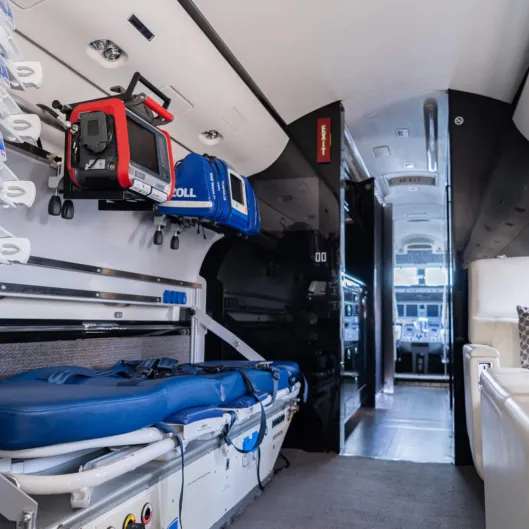
Medical repatriation is the coordinated transfer of a patient across international borders under active clinical supervision. It is not simply booking a seat on a commercial flight with a nurse escort. A true royal ambulance medical repatriation Sri Lanka 2024 operation involves a pre-flight medical assessment, a flight crew with ICU-trained personnel, on-board equipment equivalent to a mobile intensive care unit, and direct handover to a receiving hospital at the destination.
EMS Ambulance operates in 136 countries and has completed over 5,000 repatriation missions globally since 2010. A dedicated team of 50+ certified medical professionals—including ICU nurses, emergency physicians, and paramedics—handles every stage from first call to final hospital admission. This integrated model ensures families coordinate with a single provider rather than managing multiple unknown parties across borders.
For a detailed explanation of every stage in the repatriation process, our comprehensive guide on medical repatriation meaning, what it is, and when you need it covers the full clinical and logistical picture.
Royal ambulance service capabilities in Sri Lanka in 2024
Sri Lanka presents specific logistical challenges that any competent repatriation provider must address proactively. Colombo's Bandaranaike International Airport (CMB) handles approximately 85% of medical evacuation departures from the country, but patients in Galle, Kandy, Trincomalee, or remote coastal areas require coordinated ground ambulance transport before the air phase begins. Ground journey times to CMB range from 90 minutes to over five hours depending on location and traffic conditions.
In 2024, the average international air ambulance mission from Sri Lanka to Western Europe covers approximately 8,500 kilometres and requires two fuel stops depending on aircraft type, adding three to four hours to total transfer time. EMS Ambulance accounts for these factors in every mission plan. A free, all-inclusive quotation is issued within 30 minutes of first contact, with detailed logistics and medical assessment provided.
The transport options for a royal ambulance medical repatriation Sri Lanka 2024 case depend entirely on the patient's clinical condition:
- Air ambulance: A dedicated medical aircraft with full ICU capability, used for critical or ventilated patients who cannot tolerate commercial flight conditions.
- Medical escort on commercial flight: A certified medical professional accompanies a stable patient on a scheduled airline, reducing cost (typically 40-60% lower than dedicated aircraft) while maintaining continuous clinical oversight.
- Private medical jet: Faster routing and enhanced flexibility for high-acuity cases or time-critical transfers, with departure within 6-12 hours in most cases.
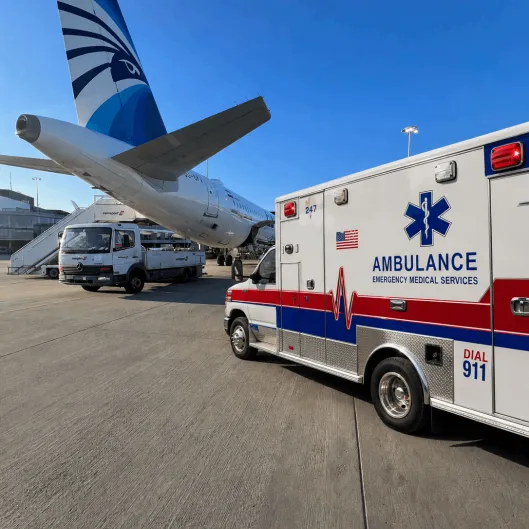
- Road ambulance coordination: Ground transport linking the patient's location to departure airport and then to receiving hospital on arrival, managed by vetted local partners.
Emergency medical evacuation: how the process works step by step
When a family contacts EMS Ambulance about a patient in Sri Lanka, clinical intake begins immediately and the mission can be confirmed within 30 minutes. A medical coordinator collects the patient's current diagnosis, hospital records, vital signs, and any active treatments such as ventilation or intravenous medication. This information determines which transport method is appropriate, what on-board equipment the mission requires, and whether pre-departure stabilization is needed.
Once the mission is confirmed, the sequence follows this standardized protocol:
- Medical file review and fitness-to-fly assessment by an in-house physician within 2 hours of initial request.
- Aircraft or commercial flight booking, with medical configuration and crew specialization specified to the operator.
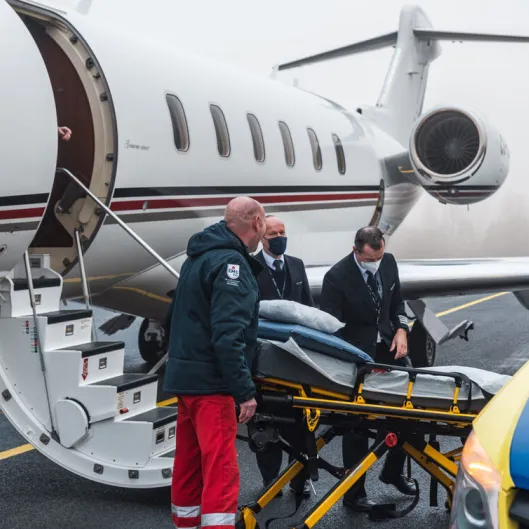
- Ground ambulance dispatch in Sri Lanka to collect the patient from their current ward or medical facility.
- Airport clearance and customs coordination for medical equipment and any controlled substances.
- In-flight monitoring and treatment by an ICU nurse and, where required, an accompanying physician.
- Arrival ground ambulance transfer directly to the receiving hospital in the destination country.
- Clinical handover with a full written medical report to the receiving medical team.
This bed-to-bed model is the standard EMS Ambulance applies to every mission, regardless of transport method. A patient is never left unattended in a departure lounge or waiting for uncoordinated transport on arrival. For clinical context on why this continuity of care is critical to patient outcomes, our article on why bed-to-bed service is so important in medical repatriation provides evidence-based detail.
Documentation and legal requirements for repatriation from Sri Lanka
International patient transport from Sri Lanka requires a defined set of documents before departure is legally permitted by Sri Lankan aviation and health authorities. Delays at this stage account for approximately 35% of mission postponements, and families are often unprepared for the administrative complexity involved.
Required documentation typically includes:
- A fit-to-fly certificate issued by the treating physician at the Sri Lankan hospital, confirming the patient can tolerate transport.
- A complete medical summary, including diagnostic imaging reports, recent laboratory results, and the current medication list with dosages.
- Valid travel documents for the patient, including passport and, where applicable, visa status for the destination country.
- Customs clearance documentation for medical equipment and any controlled substances transported on board.
- Written informed consent from the patient or legal guardian authorizing the transfer and transport method.
- Confirmation of receiving hospital admission in the destination country, including bed assignment where possible.
EMS Ambulance handles all documentation coordination as an integral part of the repatriation mission. The operations team has direct experience with Sri Lankan hospital administration procedures and maintains formal relationships with government health authorities, removing a significant administrative burden from families already managing a medical crisis abroad.
A practical detail often overlooked: some Sri Lankan private hospitals issue fit-to-fly certificates only after outstanding invoices are paid. EMS Ambulance advises families to clarify hospital billing status and ensure payment or formal guarantee arrangements are in place before fixing the departure date, as a 24-hour delay at this stage can generate unnecessary standby costs.
Cost and insurance considerations for 2024 repatriations from Sri Lanka
The cost of a royal ambulance medical repatriation Sri Lanka 2024 mission is determined by three primary factors: the clinical complexity of the patient's condition, the transport method selected, and the distance to the destination country. A medical escort on a commercial flight from Colombo to Amsterdam typically costs between €3,000 and €8,000. A dedicated air ambulance on the same route ranges from €35,000 to €80,000, depending on aircraft type, medical crew composition, and mission complexity.
EMS Ambulance pricing is all-inclusive: no separate charges apply for medical crew time, in-flight medication, oxygen systems, monitoring equipment, or ground ambulance coordination at either end. For a comprehensive breakdown of how pricing varies across different mission types and how to budget effectively, our guide on air ambulance cost: what you pay, why it varies, and how to plan ahead provides detailed cost scenarios before decisions are made.
Travel insurance coverage for medical repatriation varies significantly between policies. Policies that include emergency medical evacuation cover typically reimburse 80-100% of the cost of an air ambulance if the treating physician certifies that adequate local care is not available. Approximately 72% of comprehensive international travel policies include medical evacuation coverage. Some insurers require pre-authorization before the mission departs. EMS Ambulance works directly with insurance assistance desks and claims teams to obtain that authorization rapidly, reducing delays and out-of-pocket exposure for families.
EMS Ambulance holds TÜV ISO 9001:2015 certification, confirming that quality management processes meet internationally audited standards. The service maintains a 4.5-star global rating across independent review platforms, with 94% of families reporting satisfaction with mission coordination and clinical care.
Frequently asked questions
How quickly can EMS Ambulance arrange a medical repatriation from Sri Lanka?
For medical escort missions on commercial flights, departure can typically be arranged within 24 to 48 hours of the initial request, provided hospital documentation is ready. Dedicated air ambulance missions from Sri Lanka require 12 to 36 hours from mission confirmation to aircraft departure, depending on aircraft availability and airport slots at Bandaranaike International Airport. EMS Ambulance issues a complete quotation with mission timeline within 30 minutes of your first contact, enabling immediate planning.
Is a dedicated air ambulance always necessary, or can a stable patient fly commercially with medical escort?
Not every repatriation requires a dedicated aircraft. A stable patient who can sit upright or recline in a standard airline seat, maintain their own airway independently, and tolerate normal cabin pressure changes (typically 6,000-8,000 feet cabin altitude) may be appropriate for medical escort on a commercial flight. The decision rests on a formal fitness-to-fly assessment by a physician. Patients on mechanical ventilators, those with active cardiac instability requiring continuous monitoring, or those requiring IV medication infusions always require a dedicated air ambulance with full ICU capability on board.
What happens if the patient's condition changes during the flight from Sri Lanka?
Every EMS Ambulance mission carries on-board medical equipment and medications matched to the patient's known clinical profile and potential complications. The medical crew is trained in managing in-flight deterioration, including cardiac arrest, respiratory failure, and haemodynamic instability. For long-haul routes beyond 6 hours flight time, the operations team identifies diversion airports along the planned route before departure, ensuring the crew always has contingency landing options. No mission departs without a documented diversion strategy in place.
Does EMS Ambulance coordinate with Sri Lankan hospitals directly?
Yes. Medical coordinators contact the treating physician and clinical team at the Sri Lankan hospital to collect patient records, discuss current clinical status, and coordinate the handover from ward to ground ambulance. This direct communication between EMS medical staff and the treating hospital reduces errors, ensures the transport crew arrives fully briefed on the patient's condition, and clarifies any last-minute clinical changes. Families do not need to act as intermediaries between the hospital and the EMS medical team.
Can repatriation from Sri Lanka be covered by travel insurance?
Many comprehensive travel insurance policies include emergency medical evacuation cover, which reimburses most or all costs of a repatriation mission from Sri Lanka. The standard requirement is a physician's certification that adequate medical treatment is not available locally or that the patient requires specialist care unavailable in Sri Lanka. EMS Ambulance works directly with insurance assistance desks to obtain pre-authorization and submits clinical documentation on behalf of the family, reducing out-of-pocket exposure and accelerating approval timelines.
If you need to arrange royal ambulance medical repatriation Sri Lanka 2024 for a family member, contact EMS Ambulance now for a free, all-inclusive quotation within 30 minutes. You can also learn more about the full repatriation process at our medical repatriation definition and service overview.
Need medical transport?
Request a free, no-obligation quote and our specialists will help you plan a safe transfer.
Related blogs