Medical emergency flights southwest: what you need to know when every hour counts
Medical emergency flights southwest are specialized air ambulance and medical repatriation services that transport critically ill or injured patients across southwestern regions, including the American Southwest, the Caribbean, and surrounding areas, with onboard medical teams providing intensive care-level care during transport. When a medical crisis strikes far from home, a dedicated medical flight is often the only safe way to get a patient back to specialist care. Speed, specialist support, and coordination determine outcomes.
What medical emergency flights southwest actually involve
A medical emergency flight southwest is a specialized air transport service that combines a fully equipped aircraft with an onboard medical team to move patients who are too unstable or too distant to travel by commercial means. This is not a standard charter flight with a first-aid kit. The aircraft carries intensive care-level equipment, and the medical crew typically includes a flight physician, a specialized nurse, and a paramedic, all certified for aeromedical transport.
The difference between a standard air ambulance and a true emergency medical flight comes down to crew qualification and equipment depth. A fully configured aeromedical aircraft carries ventilators, cardiac monitors, infusion pumps, and emergency medication at the same level found in a hospital ICU. This matters when a patient needs continuous monitoring at altitude, where cabin pressure changes can worsen conditions like pneumothorax, pulmonary edema, or head injuries. The cabin altitude of a pressurized aircraft typically maintains an equivalent of 6,000 to 8,000 feet above sea level, which reduces blood oxygen saturation by approximately 4% in healthy adults—a clinically significant reduction in critically ill patients with compromised respiratory function.
- Air ambulance: Dedicated medical jet with full ICU equipment and a specialist crew for rapid, long-distance transport of critical patients
- Medical escort: A certified medical professional accompanies a stable patient on a scheduled commercial flight, reducing cost significantly
- Private medical jet: A configured private aircraft used when standard air ambulance capacity is unavailable or when privacy is a priority
- Rapid response team: A ground-based team deployed within hours to stabilize a patient at the point of care before the flight begins
Choosing the right service type is not always straightforward. A patient recovering from a stroke who is stable but non-ambulatory may need only a medical escort, not a full air ambulance. Getting this assessment wrong costs time and money. EMS evaluates each case individually within 30 minutes of first contact and provides a no-obligation quote matched to the clinical need.
Why the southwest region creates specific transport challenges
The southwestern United States, Mexico, Central America, and the Caribbean present distinct logistical obstacles for medical emergency flights. Desert terrain, island geography, limited runway infrastructure, and variable weather all affect departure timing and aircraft selection. Fewer than 30% of island airports in the Caribbean can accommodate full-size jet air ambulances, which means turbo-prop aircraft or staged transfers are often required.
Patients who fall ill on cruises or remote island resorts face an added layer of complexity. A medical evacuation from a ship anchored off Curaçao, for example, requires coast guard or tender coordination before the patient even reaches an airport. EMS has coordinated medical repatriation from cruise ships in this region and manages vessel coordination, port authority communication, and local hospital liaison work that many air ambulance providers overlook.
Smaller Caribbean or Pacific Southwest islands present additional operational constraints. A receiving airport may lack night lighting, instrument approach capability, or fuel availability, which can delay a medical flight by 12 to 24 hours if the transport team does not account for them in advance. Our article on medical repatriation from remote islands covers these scenarios in detail.
The medical approval process: a step most families don't expect
Before any medical emergency flight southwest departs, a formal medical approval process must occur. The receiving hospital must confirm it has a bed, the appropriate specialist, and the capacity to admit the patient on arrival. Without this confirmation, the flight may land with nowhere to go.
EMS coordinates the entire approval chain in parallel with flight planning. While the medical team reviews the patient's clinical records, the coordination team contacts the receiving facility and confirms the admission slot. In most cases this takes 2 to 6 hours. For time-critical cases such as organ transport or acute neurological events, this can be compressed to under 90 minutes through pre-established hospital relationships in over 136 countries. Read more about how the air ambulance medical approval process works before transport begins.
- Initial medical assessment: clinical records reviewed by a flight physician within 30 minutes of first contact
- Transport classification: patient assigned to air ambulance, medical escort, or private jet based on clinical status and distance
- Receiving hospital coordination: admission confirmed at the destination facility before departure is scheduled
- Flight planning: route, fuel stops, crew composition, and aircraft type finalized with regulatory clearances filed
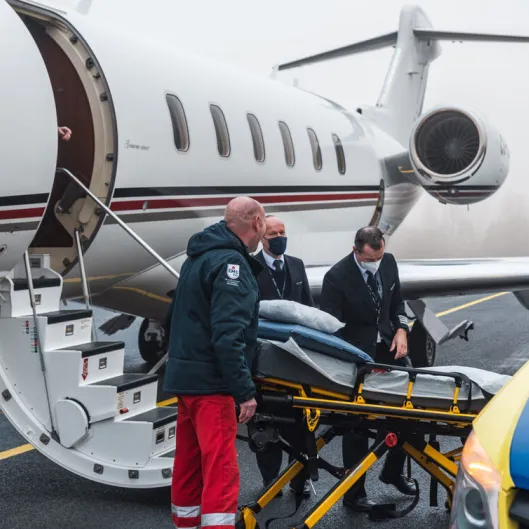
- Patient transfer: bedside pickup at the sending facility, continuous monitoring en route, bedside handover at destination
Key statistics that explain why preparation matters
Response time is the single most critical variable in emergency aeromedical transport. The gaps between providers are significant and directly affect patient outcomes in medical emergency flights southwest.
- EMS issues a free quote within 30 minutes of first contact, compared to an industry average that often exceeds 2 hours for complex international cases
- Fewer than 30% of Caribbean island airports can accommodate full-size jet air ambulances, requiring turbo-prop aircraft or staged transfers for the majority of island evacuations
- Over 50 certified medical professionals are available across EMS, including flight physicians, ICU nurses, and paramedics trained specifically for aeromedical environments
- Cabin altitude in pressurized aircraft reduces blood oxygen saturation by approximately 4% in healthy adults and can be clinically significant in critically ill patients with compromised respiratory function
Families who have used EMS services for medical emergency flights southwest rate the organization 4.5 stars globally, reflecting consistent outcomes across diverse geographies and case types in the southwestern region and beyond.
How EMS approaches southwest medical repatriation differently
Medical emergency flights southwest require more than an aircraft and a willing crew. They require a team that knows the regional airports, has relationships with local hospitals in Mexico, the Caribbean, and Central America, and can manage family communication at every step. EMS operates as a single point of contact from the moment you call to the moment your loved one is settled in their receiving ward.
Bed-to-bed service means EMS picks up from the bedside at the sending hospital, provides uninterrupted medical care throughout the flight, and delivers to the bedside at the destination. Families do not manage logistics, chase paperwork, or coordinate between subcontractors. Whether the journey starts in Tucson, Cancun, or a remote resort in the Lesser Antilles, EMS handles every step. For detailed expectations, read our guide on medical repatriation from the Caribbean, which explains what to expect in southwestern and island repatriation cases.
Frequently asked questions about medical emergency flights southwest
How quickly can a medical emergency flight southwest be arranged?
EMS can have an air ambulance airborne within 4 to 8 hours of the initial request, depending on the patient's location and clinical condition. Remote island or desert locations may add 2 to 4 hours for ground coordination. A free quote is issued within 30 minutes and parallel planning begins immediately. Stroke and cardiac cases are escalated automatically to rapid response protocol, reducing deployment time in time-critical scenarios.
What medical conditions qualify for an emergency medical flight southwest?
Any condition that makes standard commercial travel unsafe or impossible qualifies for medical emergency flights southwest. This includes post-surgical patients requiring monitoring, stroke and cardiac patients, trauma cases, patients requiring stretcher transport, psychiatric emergencies requiring supervision, and patients on ventilators or drips. Stable patients who need a qualified escort can travel on commercial flights with a medical professional, which reduces cost substantially while maintaining clinical safety.
How much does a medical emergency flight southwest typically cost?
Costs for medical emergency flights southwest depend on distance, aircraft type, crew composition, and medical complexity. Short regional flights within the U.S. Southwest typically range from $15,000 to $25,000. International air ambulance flights from the Caribbean or Mexico to Europe range from $40,000 to $120,000 or more. EMS provides all-inclusive, market-based pricing with no hidden fees, and many international health insurance and travel insurance policies cover a significant portion when medical necessity is documented.
Is medical repatriation from the Caribbean or Mexico considered an emergency flight?
Medical repatriation from the Caribbean or Mexico qualifies as a medical emergency flight southwest when the patient requires ongoing medical care during transport. Classification depends on clinical stability, distance to the receiving facility, and the adequacy of care at the current location. EMS assesses each case individually and recommends the most appropriate transport level for medical emergency flights southwest, from full air ambulance to medical escort on a commercial carrier.
What happens if my loved one is on a cruise ship in the southwest region?
Cruise ship medical evacuations in the southwest region require coordinating with the ship's medical officer, port authorities, and local coast guard or tender services before the patient reaches an airport for medical emergency flights southwest. EMS manages the entire chain, including vessel coordination, ground transfer to the departure airport, and the air ambulance flight itself. Regardless of location, EMS handles every step from ship to receiving ward bedside.
Need medical transport?
Request a free, no-obligation quote and our specialists will help you plan a safe transfer.
Related blogs