Air ambulance: what it is, how it works, and when you need it
An air ambulance is a specially equipped aircraft that provides emergency medical care and patient transport, combining the speed of aviation with the clinical capabilities of an intensive care unit. When a patient is too unstable to travel on a commercial flight, or when ground transport would take too long, an air ambulance fills that gap. At EMS, we operate across 136+ countries to bring patients home safely, with the right care at every altitude.
What air ambulance services provide
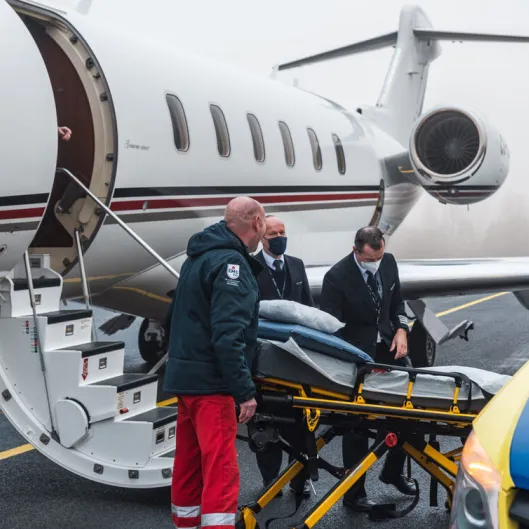
An air ambulance service delivers continuous, hospital-grade medical care from the moment the team arrives at the bedside until the patient is handed over to the receiving facility—a true bed-to-bed service that goes far beyond simple transportation.
At EMS, our air ambulance operations include a full pre-transport medical assessment, coordination with both the sending and receiving hospitals, and real-time monitoring throughout the flight. Families receive a clear timeline, regular updates, and a dedicated case manager. In practice, smooth coordination between ground and air teams cuts transfer times by hours compared to poorly organized transports, which matters enormously when a patient's condition is time-sensitive.
- Full bed-to-bed transport from hospital to hospital, including ground ambulance connections at both ends
- Medical escort by certified doctors and nurses trained in aviation medicine and critical care
- 24/7 availability with a free quotation delivered in under 30 minutes
- Aftercare coordination, including briefing the receiving medical team on the patient's status
- Comprehensive documentation, including flight medical records and transfer reports
Types of aircraft used in medical transport
The aircraft type is selected based on three factors: the patient's medical condition, the distance to be covered, and the destination's airport infrastructure. Choosing the wrong type creates real clinical risks.
For short to medium distances (up to 1,000 km), fixed-wing turboprops such as the Cessna Citation or King Air 200 are common. For long-haul international flights exceeding 2,000 km, larger jets like the Learjet 60 or Bombardier Challenger 604 are better suited: they carry more equipment and reach higher service ceilings. Helicopters are reserved for rapid local transfers, particularly from accident scenes to trauma centers. One detail that surface-level overviews often miss: cabin altitude matters. Aircraft that cannot maintain sea-level cabin pressure can worsen the condition of patients with respiratory or cardiac issues, which is why EMS carefully matches aircraft type to each patient's clinical profile. You can read more in our guide on sea-level medical flights and cabin pressure.
Medical equipment and staffing on air ambulances
A properly equipped air ambulance carries the same core technology found in a hospital intensive care unit, adapted and certified for aviation use. Two medical professionals is the accepted minimum for staffing; complex cases often require three.
Standard onboard equipment includes a ventilator, defibrillator, cardiac monitor, infusion pumps, suction devices, and a full emergency drug kit. EMS's 50+ certified medical professionals include physicians, intensive care nurses, and paramedics, all trained specifically in aeromedical transport. This is not general emergency medicine applied to aircraft—aeromedical care requires separate training to manage the physiological effects of altitude, including gas expansion in body cavities and reduced oxygen partial pressure.
- Mechanical ventilator adapted for in-flight use and altitude pressure changes
- 12-lead ECG monitor with continuous cardiac rhythm display
- IV infusion pumps and full pharmacological emergency kit
- Incubator transport systems for neonatal and pediatric patients
- Portable ultrasound for select critical cases requiring onboard diagnostics
When air ambulance services are necessary
An air ambulance is necessary when speed, medical continuity, or geography makes any other form of transport inadequate or unsafe. Patients requiring mechanical ventilation, inotropic support, or constant neurological observation should never travel on commercial aircraft according to transport medicine guidelines.
Typical situations include post-surgical repatriation of stable patients over distances exceeding 500 km, stroke recovery transport within critical time windows, trauma patients stable enough to move but requiring continuous monitoring, and organ transplant patients with strict time-sensitive constraints. EMS also arranges air ambulance transport for patients with complex psychiatric conditions who require a controlled, supervised environment throughout the journey. If you are unsure whether your situation qualifies, our team provides a medical assessment and a free quote in under 30 minutes. For those in island regions, our article on air ambulance services in Nassau, Bahamas shows how geography alone can make air transport the only viable option.
Air ambulance vs. ground ambulance: a direct comparison
Ground and air ambulances each have a clear role in medical transport. The right choice depends on distance, terrain, patient acuity, and time. The clinical picture determines everything.
| Factor | Air ambulance | Ground ambulance |
|---|---|---|
| Speed over long distances | Significantly faster (450+ km/hour cruise speed) | Slower (80–120 km/hour), limited by roads |
| Medical equipment capacity | ICU-level setup possible | Advanced life support standard |
| Cost | Higher, reflects complexity and speed | Lower for short distances (under 200 km) |
| Geographic reach | 136+ countries, remote areas, islands | Road-accessible locations only |
| Patient comfort on long trips | Better for distances over 200 km | Tiring and disruptive beyond 2–3 hours |
For a full cost breakdown before making a decision, our detailed guide on air ambulance costs, pricing factors, and how to plan ahead explains what you actually pay and why prices vary by case.
International air ambulance operations
International air ambulance transport involves complexity that domestic transfers do not face. Overflight permits, customs clearance for medical equipment, cross-border documentation, and receiving hospital coordination must all happen simultaneously, often under time pressure.
EMS operates in 136+ countries and manages this coordination directly, so families and referring hospitals do not have to navigate foreign bureaucracies alone. We handle permit applications, border formalities, and hospital liaison in the destination country as part of every transport. Our TÜV ISO 9001 certification means every process is documented and audited. For families arranging transport within Europe, our guide on air ambulance services in the United Kingdom covers the specific requirements and what to expect during the process.
Frequently asked questions about air ambulance
What is an air ambulance and how is it different from a regular flight?
An air ambulance is a medically equipped aircraft staffed by doctors and nurses trained in aviation medicine, configured with a stretcher, ICU-level medical equipment, and onboard clinical care—unlike commercial flights that carry passengers in seats. The aircraft route, altitude, cabin pressure, and flight schedule are all adapted to the patient's medical needs rather than airline timetables. Patients receive continuous monitoring and clinical intervention throughout the journey by trained aeromedical professionals.
How much does an air ambulance cost?
Air ambulance costs vary based on distance, aircraft type, medical staffing level, and patient acuity. Domestic transfers typically range from 8,000 to 15,000 euros, while intercontinental long-haul transports range from 30,000 to 100,000 euros or higher. EMS provides a free, all-inclusive quotation in under 30 minutes, specifying the exact aircraft, medical team configuration, and total cost so families understand the investment before proceeding.
When should I choose an air ambulance instead of a medical escort on a commercial flight?
Choose an air ambulance when the patient requires a stretcher, oxygen, mechanical ventilation, intravenous medication, or continuous cardiac or neurological monitoring. A medical escort on a commercial flight is suitable only for stable patients who can sit in business class without active clinical intervention during flight. If there is uncertainty about patient stability, an air ambulance is the clinically safer choice and is recommended by transport medicine guidelines.
How quickly can an air ambulance be arranged?
EMS typically mobilizes an air ambulance team within 4 to 12 hours of transport confirmation, depending on aircraft availability at the departure point, medical configuration requirements, and whether international permits are needed. For urgent domestic or short-haul European transports, same-day departure is often possible. Contact EMS and receive a full timeline as part of your free quote.
Is an air ambulance covered by travel insurance?
Many comprehensive travel insurance policies include air ambulance cover, but limits and conditions vary significantly between providers—some cap reimbursement at 50,000 euros, which may not cover long-haul transport. Review your policy document for specific coverage terms before travel. If your insurer is managing the transport, EMS works directly with insurers and assistance companies, handling paperwork so you can focus on recovery.
At EMS, we handle every detail of the transport so you do not have to. No matter where your loved one is, we will safely bring them home with the right medical care, the right team, and the right aircraft for their condition. Reach out today and receive a free, all-inclusive quote in under 30 minutes.
Need medical transport?
Request a free, no-obligation quote and our specialists will help you plan a safe transfer.
Related blogs