
medevac
Medevac: medical evacuation when staying put is not an option
Last reviewed
In 3 einfachen Schritten völlig unverbindlich Ihr Angebot
Sie können sich darauf verlassen, dass unser Preis marktgerecht und allumfassend ist und es uns ermöglicht, die bestmögliche Versorgung zu gewährleisten.

Ambulanzflug

Medizinische Flugbegleitung
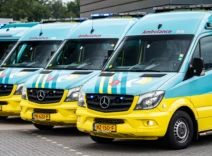
Privater Krankentransport
Evacuations often start far from a hospital. The routing works back from the nearest runway that can take the aircraft.
- Typical departure
- Within hours
- Crew
- Doctor and flight nurse
- Coverage
- Worldwide
- Pricing
- Fixed, upfront
Medevac, air ambulance, casevac: what is the difference?
The terms overlap and are often used interchangeably, which makes searching for them confusing. In practice:
Medevac
Medical evacuation. Emphasises moving the patient away from a place: a country with inadequate care, a remote site, a disaster area. The transport can be an aircraft, a helicopter or a road ambulance.
Air ambulance
Describes the vehicle rather than the mission: an aircraft equipped as an intensive care unit. Most civilian medevacs are flown by air ambulance.
Casevac
Casualty evacuation, a military term for moving casualties without dedicated medical care on board. Not what a civilian patient needs, and not what we do.
If you are searching for "medevac" because a relative is in hospital abroad, the service you are looking for is usually a medical repatriation.
When a medevac is the right call
A medevac is justified when the gap between the care available and the care needed is large enough to affect the outcome. Common situations:
- The local hospital cannot provide the specialism the condition requires, such as neurosurgery, cardiac surgery or a burns unit
- Diagnostics are unavailable, so treatment is being guessed at rather than directed
- The patient is in a remote location: an island, an offshore installation, an expedition or a rural region hours from any hospital
- Political instability, a natural disaster or an outbreak makes staying unsafe
- The patient needs continuity of care with their own specialist at home for a chronic or complex condition
What happens on a medevac flight
The flight itself is the least complicated part. The work sits either side of it.
Before. Our doctor speaks with the treating physician to establish the clinical picture and fitness to fly. A receiving hospital must accept the patient. Permits, slots and, for some destinations, visas for the crew are arranged in parallel. For remote pickups the nearest usable runway determines the routing, and a road ambulance covers the rest.
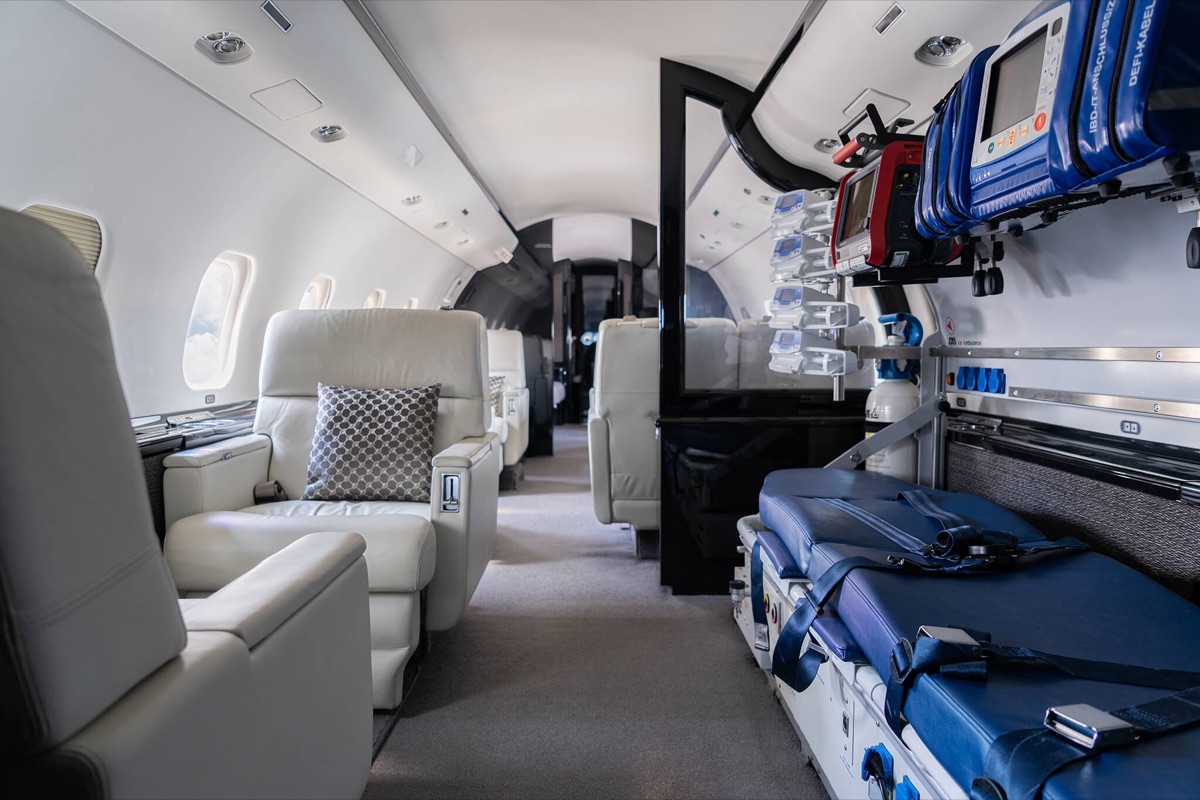
During. Care does not pause. The patient is monitored continuously, medication continues on schedule, and the cabin altitude is managed to suit the condition — which matters for head injuries, severe anaemia and decompression illness.
After. Handover happens at the receiving bedside, with a written medical record of the journey. The family is told when the patient has arrived.
Cost, and who usually pays
A medevac is priced on distance, aircraft and crew. Each fuel stop on a long route adds landing fees, handling and a permit, so the total steps up rather than rising smoothly with distance. We quote a fixed total for your specific case once we know the route and the clinical picture.
Payment usually comes from one of four places: a travel or health insurer, an employer for business travel or expatriate staff, a membership or assistance programme, or the family privately. If it is the last of these, tell us at the start. For a stable patient an escorted flight often achieves the same result at a quarter of the cost, and that conversation is worth having before an aircraft is quoted.
Evacuating from places without an airport
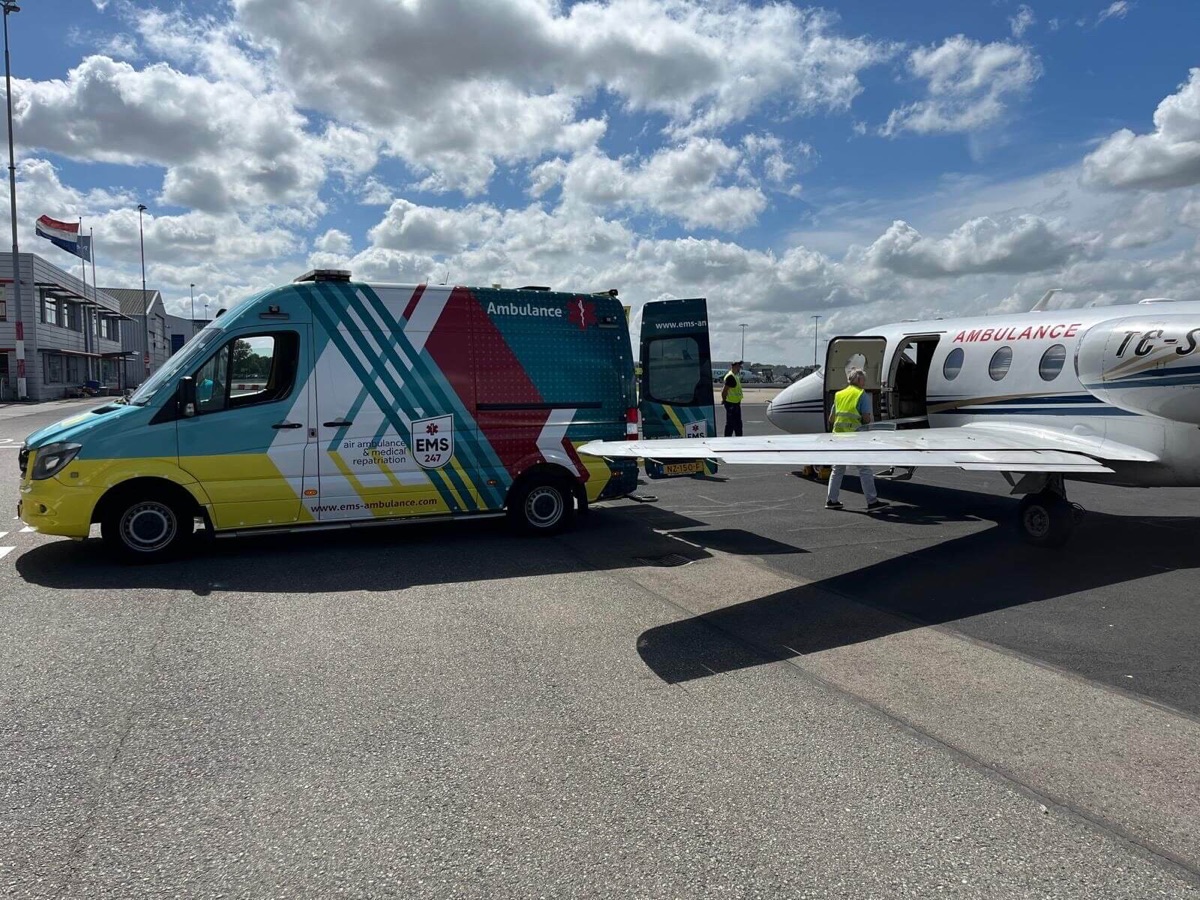
A significant share of medevacs start somewhere a jet cannot land: an island with a short strip, an offshore installation, a mining camp, a ship, a trekking route. The aircraft is then only the middle section of the journey.
The planning works backwards from the nearest runway that can take a suitable aircraft, and the gap is covered by whatever fits: a road ambulance over poor roads, a helicopter, a boat transfer, occasionally a local charter to a larger field. Each handover is a point where care can be interrupted, so the medical team travels out to meet the patient rather than waiting at the aircraft.
For remote pickups the useful thing to send us first is not a hospital name but coordinates or a precise description of the location, plus what transport already exists there. We work out the rest.
Who pays, and what usually goes wrong with that
Payment for a medevac comes from one of four places, and each fails in its own characteristic way.
Travel or health insurance
The most common source and the most common source of trouble. Nearly every policy requires prior authorisation. Arranging the transport first and claiming afterwards is the single biggest reason cover is refused, and it is entirely avoidable.
Employer or expatriate cover
Usually straightforward, because there is a named contact and a standing arrangement. Check whether the cover extends to family members travelling with the employee.
Membership or assistance programmes
These often specify a particular provider or a maximum sum. Read what happens if the transfer exceeds the ceiling: some schemes pay the ceiling and leave the balance, others decline entirely.
Privately
Around one in six of the people who contact us. If this is you, say so on the first call. It changes which options we put forward and lets us look at routing and timing that bring the total down, rather than quoting an aircraft you cannot use.
What the medical team brings, and why that is the real service
The aircraft gets the attention, but the part that changes outcomes is that qualified people stay with the patient from the first bedside to the last. Three things distinguish a properly crewed medevac from transport with a nurse along for the ride.
A handover, not a pickup
The team takes a full clinical handover at the departure ward: current medication and infusion rates, the last observations, what has changed in the past twelve hours, and what the treating physician expects might happen en route. Lines, drains and airway are secured for movement before anyone touches the trolley.
Treating in place
An aircraft cannot pull over. The crew carries the equipment and medication for the complications that are foreseeable given the condition, and they are trained to manage them in a confined, noisy, vibrating cabin where a stethoscope is close to useless and you rely on monitoring and on what you can see.
A record that survives the journey
Everything that happens is written down as it happens and handed over verbally and in writing at the destination. The receiving doctor should never have to reconstruct the last twelve hours from guesswork.
Medevac in practice: three situations that come up repeatedly
The traveller in a hospital that cannot treat them
Most common by a wide margin. Someone falls ill or is injured on holiday, the local hospital stabilises them but lacks the specialism, the diagnostics or the intensive-care capacity the condition needs. The decision hinges on whether the gap between available care and required care is large enough to justify moving a sick person. That is a clinical judgement, made with the treating physician, not a preference.
The worker on a remote site
Mining, energy, construction, shipping, expeditions. Here the constraint is rarely the aircraft but the distance to a runway, and the answer is usually a chain: road or helicopter to a field, aircraft to a hospital city, ambulance to the door. Employers with staff in these places generally have standing cover, which removes the payment question and saves hours.
The patient who needs their own specialist
Chronic and complex conditions where continuity matters: a transplant recipient, a patient on an unusual regimen, a child under a named consultant. Here the case for moving is not that local care is poor but that fragmented care is risky. These transfers are often less urgent, which means a scheduled flight with an escort is frequently the right answer.
How it works
Send the request
Where the patient is, what happened, and where they need to go.
Clinical assessment
Our doctor speaks with the treating physician and judges fitness to fly.
Plan and fixed price
Routing, aircraft, crew and total cost, usually within the hour.
Clearances
Permits, slots, receiving hospital and ground transport, arranged in parallel.
Evacuation
Bed to bed, with a written medical record of the journey.
Häufig gestellte Fragen
Related services
A medevac starts with one call
Tell us where the patient is and what the situation is. Our medical team assesses it and comes back with a plan and a fixed price.