Medical emergency flights: what they are, how they work, and when you need one
Medical emergency flights are specialized air transport services that move critically ill or injured patients quickly and safely, with certified medical personnel and intensive care equipment on board. A medical emergency flight is a dedicated airborne medical service designed for patients who cannot travel without continuous clinical support and require ICU-grade equipment such as ventilators, cardiac monitors, and infusion pumps. When a health crisis strikes far from home, whether on holiday or during a work trip abroad, a medical emergency flight is often the only safe way to bring a patient to the right hospital. EMS handles the entire process, from the first call to the moment your loved one is back in their own bed.
This service differs fundamentally from a medical escort, where a nurse or doctor accompanies a stable patient on a scheduled commercial flight. Medical emergency flights operate across 136 countries with aircraft configured to carry full intensive care units in the air, staffed by 50-plus certified medical professionals trained specifically for in-flight patient care, including altitude-related changes in cabin pressure that directly affect wound drainage, pneumothorax risk, and oxygen requirements.
When a medical emergency flight is the right choice
A dedicated medical emergency flight is necessary when ground transport is too slow, the patient is unstable, or the distance spans continents. The decision depends on the patient's clinical condition, the distance to the home hospital, and what the receiving facility requires. Not every sick traveller needs a full air ambulance.
Situations that typically require a medical emergency flight include:
- Severe stroke or cardiac event requiring specialist care not available locally
- Multiple trauma after a road accident or serious fall abroad
- Rapid deterioration of a chronic condition, such as respiratory failure or organ dysfunction
- Post-surgical complications that demand immediate specialist intervention at a home centre
- Premature birth or neonatal emergency requiring a neonatal intensive care unit back home
One detail that surface-level guides often miss: the receiving hospital must confirm it can accept the patient before the flight departs. EMS coordination staff contact the destination facility directly, verify bed availability, and arrange the clinical handover. This single step prevents costly delays once the aircraft lands and ensures the patient arrives at a facility prepared to continue care immediately.
Types of medical emergency flights and how they compare
Medical emergency flights come in three main formats, each suited to a different clinical situation. Choosing the right format ensures appropriate care during transit and prevents unnecessary cost. The table below sets out the key differences.
| Service type | Patient condition | Aircraft | Medical crew |
|---|---|---|---|
| Air ambulance (dedicated) | Critical or unstable | Private medical jet | Doctor plus nurse or paramedic |
| Medical escort | Stable, mobile | Commercial airline | Nurse or paramedic |
| Stretcher on commercial flight | Stable, non-ambulant | Commercial airline | Accompanying medical professional |
For critical patients, a dedicated air ambulance is the safest option. EMS operates medical emergency flights across 136 countries with aircraft configured to carry full intensive care units in the air. Its 50-plus certified medical professionals are trained specifically for in-flight patient care, including altitude-related changes in cabin pressure that directly affect wound drainage, pneumotharax risk, and oxygen requirements. In practice, patients requiring mechanical ventilation, vasopressor support, or continuous invasive monitoring cannot be safely transported on commercial flights and require a dedicated medical emergency flight with a physician on board.
If you are weighing the options, our detailed guide on international patient travel: commercial flight or air ambulance explains exactly when each service is appropriate and what the clinical thresholds are.
What happens during a medical emergency flight
A medical emergency flight follows a structured process from the first call to the final clinical handover. EMS provides a free quote in under 30 minutes and can mobilise a crew within hours of confirmation. Speed matters, but so does accuracy in every step.
- Initial assessment: The medical coordinator reviews the patient's current condition, hospital records, and destination requirements.
- Flight planning: The route is chosen based on flight time, refuelling stops, and airport medical facilities along the way.
- Crew and equipment preparation: The medical team loads all required medications, monitoring devices, and life support equipment before departure.
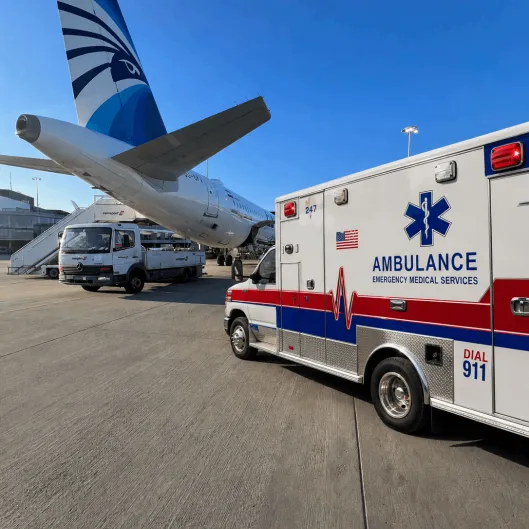
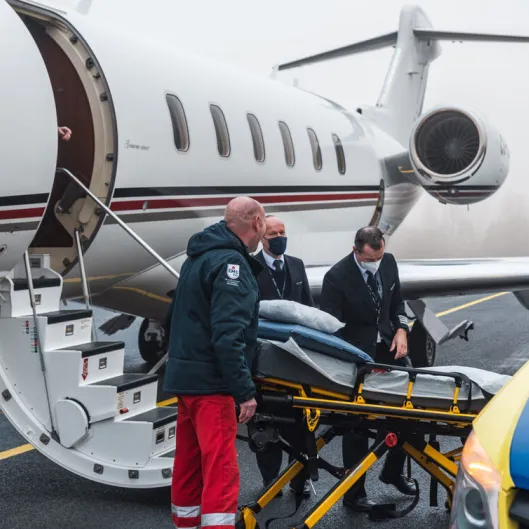
- Ground ambulance transfer: A road ambulance collects the patient from the hospital bed and transports them directly to the aircraft, as part of the bed-to-bed service.
- In-flight medical care: The onboard physician and nurse monitor vital signs continuously and adjust treatment as needed throughout the flight.
- Receiving hospital handover: On arrival, the crew transfers the patient to the destination hospital team with a full clinical briefing and documentation.
For families dealing with a crisis abroad, knowing that this process is handled end-to-end removes an enormous burden. No matter where your loved one is, EMS will transport them home safely and with continuous expert care.
Costs and insurance for medical emergency flights
Medical emergency flights carry significant costs that depend on distance, aircraft type, and clinical complexity. A transatlantic air ambulance flight typically costs between 50,000 and 200,000 euros, while flights within Europe generally range from 8,000 to 40,000 euros. These figures reflect real operational costs: aircraft charter, fuel, a two-person medical crew, and ICU-grade equipment certified for flight.
Travel insurance with medical evacuation cover is the most practical way to manage this cost. However, approximately 1 in 3 travellers who need a medical emergency flight discover their policy has exclusions they were unaware of—notably, not all policies cover repatriation to the home country, as opposed to transfer to the nearest adequate hospital. That distinction matters when you need to return home for specialist treatment. EMS works directly with insurers, assistance companies, and families paying privately, with all-inclusive pricing that means no hidden charges after the fact.
Our blog on 6 ways to speed up a medical repatriation includes practical steps you can take before a trip to ensure insurance paperwork does not slow down an emergency response when time is critical.
Special situations: children, mental health, and regional factors
Medical emergency flights for children require paediatric-specific equipment and a crew experienced in neonatal and paediatric intensive care. Standard adult air ambulance configurations are not appropriate for patients below a certain weight or age. EMS configures its aircraft and crew specifically for each patient, including the youngest and most vulnerable, with neonatal ventilators, paediatric-sized airway equipment, and crew trained in neonatal resuscitation protocols.
Mental health emergencies abroad are a growing area of need. Patients in acute psychiatric crisis may require a specially trained escort and, in some cases, a dedicated flight with appropriate in-flight support. Our article on mental health care after a medical emergency abroad explains how EMS manages this often-overlooked aspect of international patient care.
Geography shapes the complexity of a medical emergency flight too. Remote island locations, countries with limited airport infrastructure, and regions with strict airspace regulations all affect response time and routing. EMS has active operations in 136 countries because the logistics of each region require local knowledge and established contacts on the ground, enabling faster coordination when every hour counts.
Frequently asked questions
How quickly can a medical emergency flight be arranged?
EMS provides a full quote within 30 minutes of the first call and can mobilise a crew within hours of confirmation. In most European cases, departure within 4 to 8 hours of confirmation is achievable, while intercontinental flights typically require 12 to 24 hours for aircraft positioning and crew preparation. Critical cases with pre-arranged coordination can sometimes depart faster, depending on aircraft availability and flight clearances.
What medical equipment is on board a medical emergency flight?
A fully configured air ambulance carries ICU-level equipment including a ventilator, portable monitor with defibrillator, syringe and infusion pumps, suction unit, portable ultrasound in some configurations, and a comprehensive medication kit covering cardiac, respiratory, neurological, and anaesthetic needs. The exact configuration depends on the patient's diagnosis and anticipated in-flight risk profile, assessed by the medical coordinator before departure to ensure all necessary equipment is available.
Can a family member travel on a medical emergency flight?
Yes, in most cases one accompanying family member can travel on the aircraft, subject to space and weight limits. On a dedicated air ambulance, a small cabin area is usually available for one passenger alongside the medical team. On a medical escort using a commercial flight, family members can book their own seats on the same service. EMS discusses this during the initial coordination call so families are not left behind at a difficult moment.
Is a medical emergency flight different from non-emergency air ambulance transport?
Yes, they differ in urgency, equipment, and timeline. A medical emergency flight is activated for critical or time-sensitive patients requiring immediate transport within hours of the request. A non-emergency air ambulance flight is for medically stable patients requiring professional accompaniment and monitoring, with flexible scheduling. Both use certified medical crews, but medical emergency flights deploy with ICU-level equipment and a physician, whereas non-emergency flights typically have a nurse or paramedic and operate on commercial or smaller aircraft.
What documents are needed to organise a medical emergency flight?
Core documents include a current medical report from the treating hospital, a copy of the patient's passport and travel insurance policy, and written consent from the patient or their legal representative. Some countries require additional permits for medical aircraft to land and collect a patient. EMS handles regulatory paperwork across all 136 countries where it operates, so families do not have to navigate foreign bureaucracy during a crisis.
We bring your loved one home with the right care
Medical emergency flights combine aviation, intensive care medicine, international regulation, and family communication into a single coordinated response. EMS has built its entire operation around doing this reliably, with TUV ISO 9001 certification, a 4.5-star rating from families worldwide, and a team of 50-plus medical professionals available around the clock. When the call comes, we are ready. No matter where they are, we will transport your loved ones home safely.
Need medical transport?
Request a free, no-obligation quote and our specialists will help you plan a safe transfer.
Related blogs