Medevac: what it is, how it works, and when you need it
Medevac is the urgent transport of critically ill or injured patients from a location where adequate medical care is unavailable to a facility equipped to treat their condition, typically via aircraft with intensive care capability. Whether airlifting a patient from a remote island or repatriating someone across continents, medevac closes the gap between a patient's location and the care they need.
What medevac stands for and its purpose
Medevac is a contracted form of "medical evacuation" and refers to the urgent relocation of a patient, typically under active medical supervision, from a scene of injury, a local hospital with limited capabilities, or a foreign country to a facility equipped to treat their condition. The term originated in military medicine during the Korean War, when helicopter evacuations dramatically reduced battlefield mortality rates, cutting death rates among wounded soldiers from 4.5% in World War II to below 2.5%.
Today, medevac covers both military and civilian operations. In civilian contexts, it most often describes air ambulance flights that move patients across long distances when ground transport is impractical or too slow. The core purpose is always the same: get the right patient to the right care as fast as possible, without interrupting the medical treatment they are already receiving.
Medevac vs. standard ambulance services
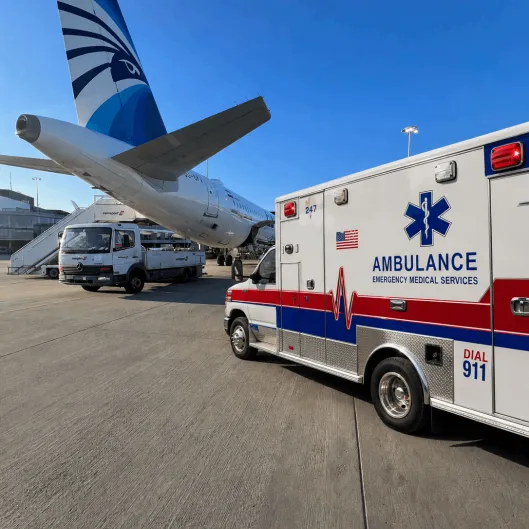
A standard ambulance handles local emergencies, typically within a city or region, and carries basic or advanced life support equipment. A medevac operation is fundamentally different in scope, equipment, and medical personnel.
- Range: Standard ambulances cover short local distances. Medevac flights routinely cross international borders and cover thousands of kilometers in a single mission.
- Medical crew: A local ambulance carries paramedics. A medevac aircraft carries physicians, intensive care nurses, and specialists depending on the patient's diagnosis.
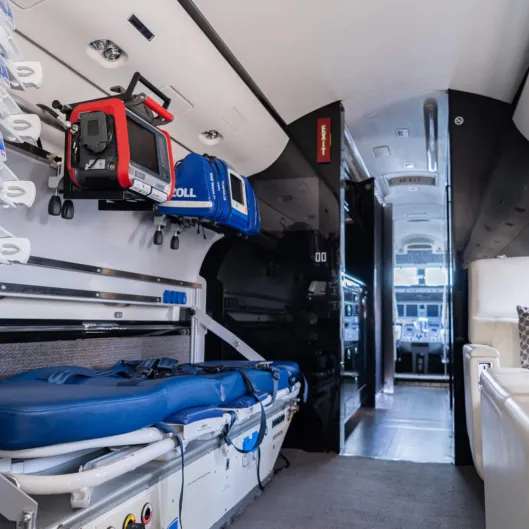
- Equipment: Medevac aircraft carry ICU-level equipment, including ventilators, infusion pumps, cardiac monitors, and incubators for neonatal cases.
- Coordination: Medevac missions require flight planning, overflight permits, customs clearance at landing sites, and pre-arranged receiving hospital teams, none of which apply to a standard ambulance call.
In practice, patients who have suffered strokes, major trauma, or cardiac events abroad often cannot safely spend 12 or more hours on a commercial flight without active intervention. A medevac flight brings the intensive care unit to the patient for the entire journey. Studies of international medical transport show that ICU-level monitoring in-flight reduces adverse events by approximately 40% compared to commercial cabin transport for unstable patients.
Types of medevac operations: air and ground
Medevac services fall into two broad categories: air-based and ground-based. Both serve distinct needs, and choosing the wrong type can delay care or increase risk to the patient.
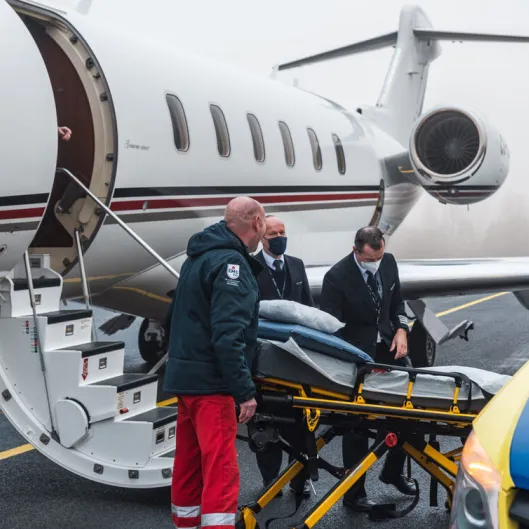
Air medevac covers three main formats. A dedicated air ambulance is a fixed-wing aircraft, often a Learjet or Pilatus PC-12, configured as a flying ICU. Helicopter medevac operates over shorter distances, typically under 150 kilometers, and is common for trauma scenes in mountainous or coastal terrain. Commercial medical escort is a lower-acuity option where a medically stable patient travels on a scheduled airline accompanied by a nurse or physician. For more detail on how a medevac flight is structured and what to expect during transport, we have a full breakdown available.
Ground medevac uses purpose-built road ambulances for inter-facility transfers when air transport is not available, not medically indicated, or not cost-effective. Cross-border road transfers are common within continental Europe, for example, where distances are manageable and border crossings are straightforward. Ground medevac typically costs 30% to 50% less than fixed-wing air transport for distances under 800 kilometers. Our air vs. ground ambulance guide for long-distance transport walks through exactly when each option makes clinical and logistical sense.
International medevac protocols and procedures
Coordinating an international medevac mission involves far more than booking a flight. Every mission requires a clear sequence of steps, and skipping any one of them can ground an aircraft or delay patient care by hours.
- Medical assessment: A physician reviews the patient's current condition, diagnosis, and treatment requirements to determine fitness for transport and the appropriate level of medical escort.
- Flight planning and permits: The operations team files flight plans, secures overflight permits for each country the aircraft crosses, and arranges landing slots at destination airports.
- Customs and border clearance: Medical equipment and medications crossing borders require advance documentation. Controlled substances carried onboard require specific narcotics import permits at the receiving country.
- Receiving facility coordination: The destination hospital is briefed before departure, so a receiving team and bed are ready the moment the patient arrives. This is the standard EMS bed-to-bed model.
- In-flight medical care: The medical team manages the patient continuously throughout the flight, adjusting treatment as needed in real time.
EMS operates medevac services across 136 countries and manages all of this coordination in-house, with 50-plus certified medical professionals and 24/7 dispatch. A confirmed quote is delivered in under 30 minutes because the operations team handles permit applications, receiving hospital contact, and crew deployment simultaneously rather than sequentially.
Cost considerations for medevac services
Medevac costs vary based on distance, aircraft type, medical crew level, and destination. A short-haul European medevac flight costs between 15,000 and 30,000 euros, while a transcontinental mission from Southeast Asia or the Americas exceeds 100,000 euros. These figures reflect the all-in cost: aircraft, crew, fuel, permits, and medical equipment. International data shows that approximately 65% of medevac missions globally are partially or fully covered by travel or health insurance, meaning families often face only deductible or coinsurance portions.
Travel insurance and international health insurance policies often cover medevac, but coverage limits and pre-approval requirements differ significantly between providers. Some policies cap air ambulance reimbursement at 50,000 euros, which may not cover a long-haul mission. Our article on air ambulance insurance coverage explains what to check in your policy before you travel and what to do if coverage falls short. For a comparison of medevac and medical repatriation, including which one your insurer is likely to fund, see our detailed guide on medevac versus medical repatriation.
One detail that surprises many families: the cost of NOT acting quickly often exceeds the cost of the medevac itself. Extended ICU stays in foreign hospitals, interpreter fees, family travel costs, and the clinical risk of delayed specialist care can accumulate rapidly. Patients delayed more than 24 hours in accessing definitive cardiac or stroke care face mortality rates approximately 2 to 3 times higher than those evacuated within 12 hours.
When medevac services are necessary
Medevac is not the right tool for every situation. For stable patients who can travel seated or in a stretcher on a commercial aircraft with a medical escort, a full air ambulance is usually unnecessary. Medevac becomes necessary when the patient's condition requires continuous monitoring, active intervention, or specialized equipment that a commercial cabin cannot provide.
- Patients on mechanical ventilation or requiring supplemental oxygen above commercial aircraft limits
- Acute cardiac or neurological events such as heart attacks, strokes, or brain injuries requiring ICU-level monitoring
- Post-surgical patients with open wounds, drains, or infection risks that cannot be safely managed in a cabin
- Neonatal or pediatric emergencies requiring incubators or specialized pediatric equipment
- Trauma patients with fractures, spinal injuries, or internal bleeding requiring positional care during transport
- Psychiatric emergencies where patient behavior poses a safety risk in a commercial environment
When in doubt, our medical team assesses the patient's file and provides a clear recommendation, at no charge and within 30 minutes. EMS will take care of it from the first call to arrival at the receiving hospital.
Frequently asked questions about medevac
What is the difference between medevac and medical repatriation?
Medevac refers to any urgent medical evacuation from a dangerous or medically underserved location, including a battlefield, remote areas, or foreign hospitals. Medical repatriation specifically means returning a patient to their home country for ongoing treatment or recovery. Many medevac missions are also repatriation missions, but not all repatriations require the emergency urgency level of a true medevac. The medical crew level and aircraft type depend on the patient's clinical condition rather than the operational label applied to the mission.
How fast can a medevac flight be arranged?
A medevac flight can be arranged within 2 to 6 hours from first contact in most cases, depending on the departure country and permit requirements. EMS provides a confirmed quote in under 30 minutes and maintains 24/7 operations staff who begin permit and crew coordination immediately upon request. In countries with straightforward overflight rules, aircraft can be airborne within 4 hours. Remote or politically complex destinations typically require 12 to 24 hours for full regulatory clearance.
Does travel insurance cover medevac costs?
Many travel and international health insurance policies include medevac or air ambulance coverage, though specifics vary widely between providers. Some policies require pre-authorization before transport, while others cap reimbursement below the actual cost of long-haul missions. Patients should verify their policy for terms including "emergency evacuation," "air ambulance benefit," and "repatriation of remains." EMS works directly with insurers and assists families in understanding coverage limits before committing to a mission.
Can medevac transport a patient who is conscious and communicative?
Yes. Medevac is not exclusively for unconscious or critical patients. Conscious patients who are medically unstable, require continuous monitoring, or cannot safely tolerate a commercial flight are regularly transported by air ambulance. The medical team adjusts care protocols to match the patient's condition throughout the flight. A conscious but medically fragile patient may require higher monitoring intensity than an unconscious but hemodynamically stable patient.
What medical equipment is on a medevac aircraft?
A dedicated medevac aircraft carries ICU-equivalent equipment, including a transport ventilator, cardiac monitor with defibrillator, infusion pumps, suction devices, and oxygen supply for the full flight duration plus a reserve. The aircraft is equipped with a comprehensive medication kit covering cardiac drugs, sedation agents, pain management, and emergency resuscitation drugs. All equipment is selected and checked before each mission based on the patient's specific diagnosis and anticipated in-flight medical needs.
Need medical transport?
Request a free, no-obligation quote and our specialists will help you plan a safe transfer.
Related blogs