EMS: what it is, how it works, and when you need it
EMS, or Emergency Medical Services, is a structured system of pre-hospital and inter-hospital care designed to deliver rapid, medically supervised assistance to patients in acute need. EMS covers the full chain from first response to safe patient transfer, whether that happens on a city street or during an overseas holiday. For international patients and families, EMS is often what separates timely recovery from a medical crisis without support.
What EMS means and its core function
EMS is a coordinated network of personnel, equipment, and transport resources that responds to medical emergencies and manages patient transfers across all distances. The system stabilizes patients at the scene, maintains that stability during transport, and delivers them safely into continued medical care. In international settings, this expands to include repatriation, medical escort, and air ambulance coordination across borders.
A true EMS provider covers the entire care continuum: initial assessment, in-transit treatment, specialist communication, and handover documentation. That is far more than a vehicle with a siren. At EMS, we operate across 136 countries with 50+ certified medical professionals, giving families a single point of contact from the moment an emergency happens to the moment their loved one is safely home.
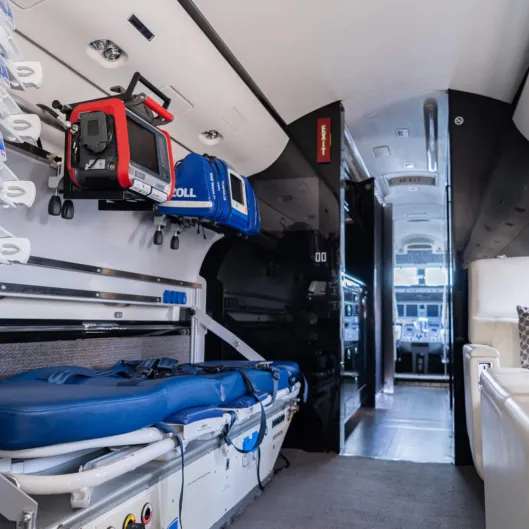
- Air ambulance: Dedicated medical aircraft with intensive care equipment for critical patients
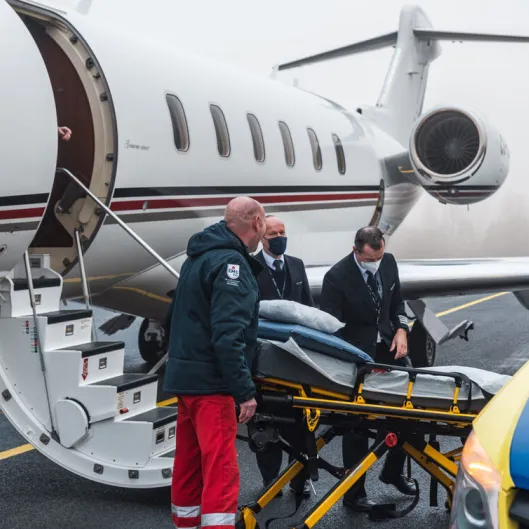
- Medical escort: A certified medical professional accompanying stable patients on commercial flights
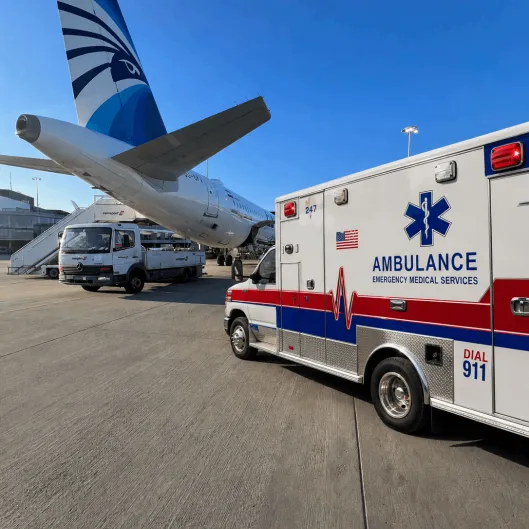
- Road ambulance: Ground transport for shorter distances or connecting legs
- Private medical jet: Fully equipped private jets for complex cases requiring maximum privacy and speed
- Rapid response team: On-the-ground emergency coordination in the immediate hours after an incident
How EMS differs from a standard ambulance service
EMS in the international repatriation context differs fundamentally from a standard local ambulance service in scope, medical depth, and coordination across healthcare systems. A standard local ambulance gets a patient to the nearest hospital and hands over responsibility at the emergency department doors. International EMS takes ownership of the entire transfer process, from the foreign hospital bed to the patient's home country facility, coordinating across borders, insurers, and multiple healthcare systems.
A standard ambulance service cannot manage a ventilator-dependent patient on a transatlantic flight, negotiate with foreign insurers, or coordinate receiving hospital logistics across two different healthcare systems. That is where specialized EMS repatriation becomes necessary. We provide bed-to-bed service, meaning the patient never loses medical supervision between departure and arrival. No gaps. No handoffs to untrained staff.
The role of EMS in emergency medical response abroad
When a medical emergency happens overseas, response time and medical coordination are critical factors in patient outcomes. Delays in organizing transport, clearing medical paperwork, or finding qualified escorts can extend a patient's hospital stay by days or even weeks. EMS closes that gap by combining medical expertise with logistical speed.
Our team delivers a free quotation in under 30 minutes, a concrete measure of how seriously we treat response time. In many cases, families contact us within hours of a loved one being hospitalized abroad, and we have transport in motion within 24 hours. We have handled psychiatric emergencies in remote parts of Africa, post-surgical cases in Southeast Asia, and cardiac events during Caribbean cruises. Each situation differs, but the process stays consistent: assess, plan, move, deliver.
Key figures that define our EMS response:
- 136+ countries covered by our active medical transport network
- 30 minutes or less for a full quotation after first contact
- 4.5-star global rating from families who have used our services
- 50+ medical professionals certified and available 24 hours a day, 7 days a week
EMS training, certification, and quality standards
Professional EMS providers operate under strict certification frameworks to ensure patient safety and care quality. Our quality system is TUV ISO 9001 certified, a globally recognized standard for quality management in service organizations. This means our processes, documentation, medical protocols, and patient handover procedures are independently audited against international benchmarks.
The medical professionals on our team include physicians, nurses, and paramedics with specialist training in transport medicine. Transport medicine is a distinct discipline from emergency room care, requiring knowledge of how altitude affects oxygenation, how to manage medication stability during long flights, and how to communicate a patient's clinical status across language barriers to receiving hospitals. That expertise is rare in general ambulance crews, and it is precisely what makes our 24/7 air ambulance service different from a standard charter with a nurse on board.
EMS response times and integration with hospital systems
Response time in international EMS is measured differently than in domestic emergency services, with the clock starting when a family or insurer calls. Key milestones follow in sequence: quotation issued, medical clearance obtained, transport confirmed, patient en route. Each step requires coordination between foreign hospitals, receiving facilities, aviation authorities, and insurance providers to reduce overall transport time.
We integrate directly with hospital discharge teams and insurance case managers, cutting average coordination time significantly compared to families arranging transport on their own. For families who want to understand the full picture before committing, our blog covers the top 5 questions about air ambulance flights in detail. Knowing the right questions can save critical hours in an emergency.
Choosing between transport options depends on the patient's clinical condition. A stable patient with a fracture travels very differently from a post-operative patient on continuous monitoring. Our medical team assesses each case individually and recommends the most appropriate service. For families weighing those choices, understanding the key reasons to choose EMS for medical transport helps clarify which service fits the situation.
Frequently asked questions about EMS
What exactly does EMS stand for in medical transport?
EMS stands for Emergency Medical Services, a complete system of medically supervised care and logistics that moves a patient safely from one location to another, whether across a city or across continents. In international patient transport, EMS covers assessment, stabilization, in-transit treatment, specialist communication, and coordinated handover to receiving medical teams. This end-to-end responsibility distinguishes EMS from standard ambulance transport, which typically ends at the nearest hospital.
When should I contact an EMS provider instead of relying on local hospital services?
Contact an international EMS provider as soon as a patient is stable enough to consider transport but needs to move to a different country or region for continued care. Local hospitals manage acute emergency care but are not equipped to handle international repatriation logistics. EMS providers manage aviation coordination, medical clearances, insurance liaison, and specialist medical escorts—all of which fall outside standard hospital discharge planning. This is essential when a patient requires care in their home country or a specialized facility abroad.
How quickly can EMS organize an air ambulance transport?
EMS issues a full quotation within 30 minutes of first contact. Actual transport timelines depend on the patient's clinical condition, required medical clearances, and flight routing. For non-critical cases with straightforward logistics, transport is typically arranged within 24 to 48 hours. For complex cases involving intensive care patients requiring ongoing medical management, 48 to 72 hours is a realistic planning window, allowing time for proper medical assessment and coordination.
Does travel insurance cover EMS and medical repatriation costs?
Many travel insurance policies include medical repatriation cover, though terms vary significantly between providers. Some require pre-authorization before transport is arranged, while others cover economy-class flights but exclude air ambulances. Coverage gaps can result in substantial out-of-pocket costs. We work directly with insurers as part of our service, helping families understand their coverage and avoid unexpected bills. Checking your policy's repatriation clause before traveling takes about ten minutes and is essential for peace of mind.
EMS brings your loved ones home safely
EMS is a medical system built around the patient's full journey, from the moment of crisis to the moment they are settled into care at home. We bring you home with the right care and expertise, backed by ISO-certified processes, a global network spanning 136 countries, and a team of 50+ medical professionals who specialize in exactly this work. No matter where they are, we will safely transport your loved ones home.
Need medical transport?
Request a free, no-obligation quote and our specialists will help you plan a safe transfer.
Related blogs