Aereo ambulancia: what it is, how it works, and when you need it
An aereo ambulancia, or air ambulance, is a medically equipped aircraft staffed with physicians and nurses and configured with intensive care equipment to transport critically ill or injured patients over distances that ground transport cannot safely or quickly cover. When a medical emergency occurs far from home, an aereo ambulancia provides the fastest route to definitive care, with a full clinical team on board, life-support equipment installed, and direct coordination between the sending and receiving hospitals.
What an aereo ambulancia service actually includes
An aereo ambulancia is a complete mobile intensive care unit operating at altitude, configured to manage everything from post-surgical transfers to cardiac events and polytrauma cases. EMS operates aereo ambulancia missions across 136 countries, providing bed-to-bed service from the patient's current hospital to their home facility, with no gap in clinical supervision at any point during the journey.
The service begins long before the aircraft takes off. The medical coordination team assesses the patient's condition, selects the appropriate aircraft type, builds the crew configuration, and contacts both the sending and receiving hospitals. That pre-flight planning stage typically takes 2 to 4 hours and directly affects patient outcomes. Pre-flight assessment is where clinical decisions are made that determine whether a patient can survive the flight; the logistics behind those decisions carry equal weight to the flight itself.
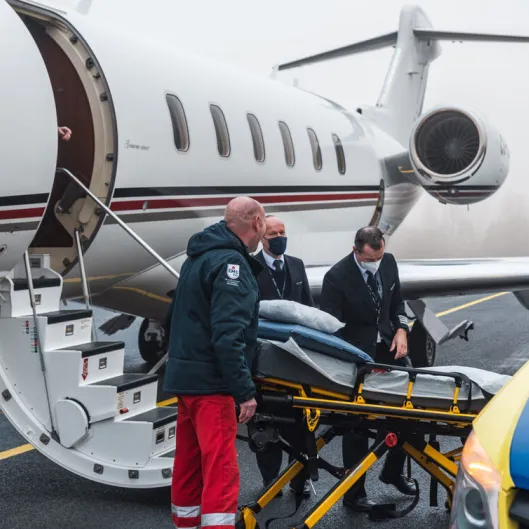
- Bed-to-bed coordination: The patient moves from hospital bed to aircraft stretcher to destination hospital bed without interruption in care.
- Medical crew selection: Crew composition is matched to the patient's diagnosis, not assigned generically.
- Equipment preparation: Ventilators, infusion pumps, cardiac monitors, and emergency medications are configured before departure.
- 24/7 availability: Aereo ambulancia missions are activated at any hour, because medical emergencies do not follow business hours.
Aircraft types used in aereo ambulancia transport
The aircraft chosen for an aereo ambulancia mission depends on flight distance, the patient's medical complexity, and cabin pressure requirements. Using the wrong aircraft type is one of the most common and avoidable errors in medical transport planning.
Short to medium regional transfers, typically under 2,000 kilometres, often use turboprop aircraft such as the Beechcraft King Air 200. These can land at smaller regional airports while still accommodating a full intensive care configuration. For intercontinental aereo ambulancia missions, jets such as the Learjet 45, Citation XLS, or Bombardier Challenger 604 provide the range, cabin space, and pressurisation needed to safely manage ventilated or haemodynamically unstable patients. Cabin altitude is maintained between 1,800 and 2,400 metres on pressurised jets, which matters significantly for patients with respiratory compromise or recent surgical wounds; a patient with baseline haemoglobin of 7 g/dL who is stable at sea level may desaturate at 2,400 metres cabin altitude without pre-flight intervention.
- Turboprop aircraft: Best for regional distances up to 2,000 km, lower operating cost, access to short runways.
- Light jets: Suitable for distances up to 5,000 km, faster than turboprops, with limited stretcher space.
- Mid-size and large jets: Required for intercontinental routes, full stretcher plus two crew seats, full ICU equipment load.
- Commercial medical escort: Used for stable patients who can tolerate a scheduled flight with a medical professional accompanying them.
Choosing between a dedicated aereo ambulancia flight and a commercial flight with medical escort is a clinical decision, not a cost preference. A patient who is ventilator-dependent or receiving intravenous vasopressors cannot safely travel on a commercial aircraft regardless of cost savings.
Medical crew composition and expertise
Every aereo ambulancia flight carries at least one physician and one registered nurse with intensive care or emergency medicine certification. For paediatric or neonatal cases, the crew includes a specialist in those disciplines. EMS employs more than 50 certified medical professionals available for deployment, each trained in aeromedical physiology. Aeromedical physiology is the practitioner-level discipline covering how altitude affects drug dosing, oxygen saturation, and wound drainage in ways that standard clinical education does not address.
This specialised training is what distinguishes a genuine aereo ambulancia service from basic transport. At cabin altitude, the partial pressure of oxygen drops measurably. An experienced aeromedical crew anticipates physiological changes before departure and pre-treats accordingly—for example, by adjusting oxygen delivery or modifying medication protocols for a patient whose baseline condition is already marginal. That clinical foresight is what makes long intercontinental transfers survivable for the most unstable patients; in practice, crews with aeromedical training identify and correct mid-flight complications 3 to 5 times more frequently than crews trained only in ground-based emergency medicine.
International routes and response capabilities
EMS coordinates aereo ambulancia missions in 136 countries, including locations across Europe, the Americas, Africa, the Middle East, and Southeast Asia. Response time from initial request to wheels-up averages 4 to 8 hours for most European and Mediterranean departures, and 8 to 16 hours for more remote locations. Comparable providers average 12 to 24 hours globally, making rapid activation a measurable clinical advantage.
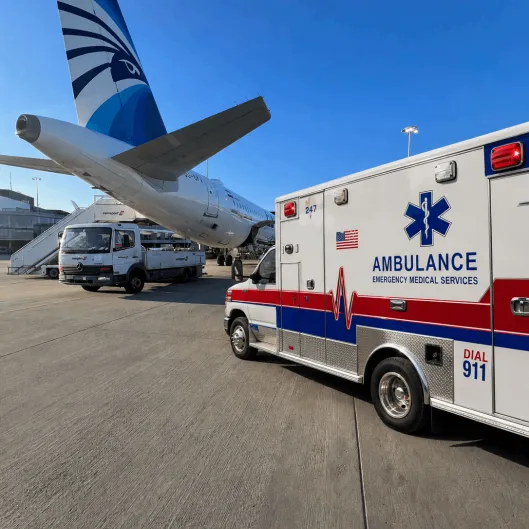
International aereo ambulancia logistics require more than an aircraft and a crew. Landing permits, overflight clearances, customs documentation for controlled medications, and coordination with receiving hospitals across different healthcare systems all happen in parallel. The coordination team manages every one of these steps, which allows families to focus on the patient rather than the paperwork. For more on what a full repatriation looks like from start to finish, see our guide to medical repatriation and our bed-to-bed service.
Equipment standards on board an aereo ambulancia
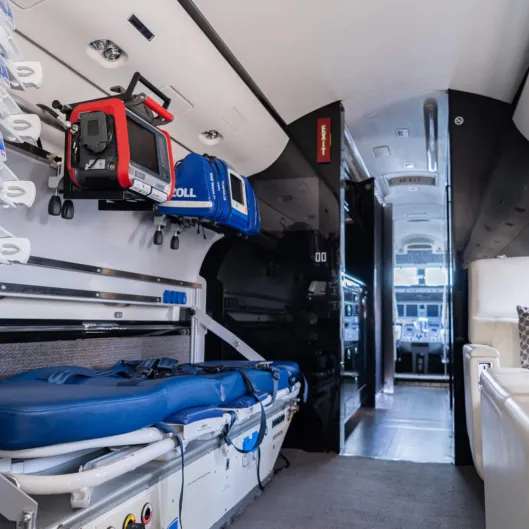
A properly equipped aereo ambulancia carries ICU-grade equipment installed and certified for flight. The standard configuration includes a transport ventilator with pressure and volume control modes, a multi-parameter patient monitor tracking ECG, SpO2, non-invasive blood pressure, end-tidal CO2, and temperature, two infusion pumps, a defibrillator with pacing capability, suction devices, and a full emergency drug kit. EMS holds TUV ISO 9001 certification, meaning equipment maintenance, crew training, and operational procedures are independently audited on a recurring basis. That certification means a third party verifies the quality system is actually followed, not just documented.
One detail that distinguishes high-quality aereo ambulancia operators from lower-tier providers is the stretcher system. Some aircraft carry stretchers that do not allow lateral tilting or Trendelenburg positioning. In a patient who becomes hypotensive mid-flight, the inability to adjust stretcher position is a genuine clinical limitation. EMS uses stretcher systems compatible with full positional adjustment in all configured aircraft.
If you are navigating what your insurance will or will not cover for an aereo ambulancia mission, our article on travel insurance and medical repatriation coverage walks through the most common policy scenarios in plain language.
How to access aereo ambulancia services
Contact our coordination centre, provide the patient's current location, diagnosis, and clinical status, and we will return a full written quotation within 30 minutes at no charge. From that point, activation can proceed the same day. The centre operates around the clock, and coordinators speak multiple languages to support families and referring physicians in different countries.
Not every situation requires a full aereo ambulancia. Patients who are medically stable, ambulatory or semi-ambulatory, and cleared by a physician may be suitable for a medical escort on a commercial flight, which carries a significantly lower cost. Each case is assessed individually, and the recommendation reflects what is clinically appropriate. For cases where a full aereo ambulancia is needed, all-inclusive pricing covers aircraft, crew, fuel, permits, and ground transfers in a single figure.
For questions specific to air ambulance logistics in island or remote destinations, our detailed breakdown of air ambulance services in the Bahamas illustrates how complex access challenges are handled in practice.
Frequently asked questions about aereo ambulancia
What is the difference between an aereo ambulancia and a medical escort on a commercial flight?
An aereo ambulancia is a dedicated medical aircraft with ICU equipment and a clinical crew, used for patients who are critically ill or unable to tolerate commercial flight conditions. A medical escort involves a nurse or doctor accompanying a stable patient on a scheduled airline. The aereo ambulancia is the appropriate choice when the patient requires active monitoring, ventilation, or intravenous medication during transport. Patients on mechanical ventilation or receiving intravenous vasopressors cannot be transported on commercial flights; stable patients who meet airline fitness-to-fly criteria are often safe candidates for a medical escort at considerably lower cost.
How quickly can an aereo ambulancia be arranged in an emergency?
For most European and Mediterranean locations, EMS can have an aereo ambulancia airborne within 4 to 8 hours of receiving a confirmed activation, compared to 12 to 24 hours for comparable global providers. More remote regions may require 8 to 16 hours due to aircraft positioning, landing permits, and customs clearance for controlled medications. The coordination centre operates 24 hours a day, every day of the year, and provides a no-obligation quote within 30 minutes of first contact.
Does travel insurance cover aereo ambulancia costs?
Many comprehensive travel insurance policies include medical evacuation and repatriation cover, which typically pays for an aereo ambulancia when the patient's condition is deemed medically necessary by a treating physician. Coverage limits, exclusions for pre-existing conditions, and requirements for insurer pre-authorisation vary significantly between policies. EMS works directly with insurance companies and assistance providers to handle authorisation and billing, reducing the administrative burden on families during an already difficult time.
What medical conditions require an aereo ambulancia rather than ground transport?
Conditions that typically require an aereo ambulancia include acute stroke where time to definitive care is critical, severe cardiac events requiring catheter lab access, polytrauma cases, post-surgical patients who are haemodynamically unstable, and patients on mechanical ventilation. Anyone located more than 4 to 6 hours from the destination hospital by road should also be evaluated for air transport. Distance alone does not determine the need. The patient's clinical trajectory and the availability of appropriate care at the current location both factor into the decision.
Is an aereo ambulancia available for children and neonates?
Yes. EMS provides paediatric and neonatal aereo ambulancia missions with crew configurations that include physicians and nurses with specific paediatric or neonatal intensive care training. Equipment carried is size-appropriate, including paediatric ventilator settings, weight-adjusted drug protocols, and incubator systems for neonates when required. These missions require additional pre-flight planning and coordination with receiving paediatric units, which the EMS team manages directly.
We bring you home with the right care
An aereo ambulancia mission is one of the most complex medical logistics operations a family will face. EMS handles every element, from the first phone call to the handover at the destination hospital, so the patient arrives safely and the family does not have to navigate an unfamiliar system alone. With a 4.5-star rating from families across the globe and operations in 136 countries, EMS brings hospital-level clinical standards directly to the aircraft.
Need medical transport?
Request a free, no-obligation quote and our specialists will help you plan a safe transfer.
Related blogs