Acompañante de vuelo médico: what it is, who needs it, and how it works
An acompañante de vuelo médico is a certified medical professional who travels on a commercial flight with a patient to provide continuous clinical supervision during air transport. This service bridges the gap between a full air ambulance and unassisted travel, enabling patients who are medically stable to fly commercially while receiving trained professional oversight throughout the journey. Families arranging international repatriation rely on this option when a patient needs clinical monitoring but does not require the intensive infrastructure of a dedicated medical aircraft.
The role of a medical flight companion
An acompañante de vuelo médico is the active clinical link between a patient's foreign hospital and their receiving care team at home. The companion actively monitors vital signs, manages medication schedules, communicates with cabin crew, and responds immediately to any change in the patient's condition—rather than simply sitting alongside the patient and hoping nothing goes wrong.
Consider a patient recovering from stroke or post-surgical procedure who has been cleared by their treating physician for commercial travel yet still requires someone trained in advanced cardiac life support for a 10-hour intercontinental flight. An acompañante de vuelo médico makes the difference between safe transfer and serious in-flight incident. At EMS, our medical companions have responded to acute in-flight deteriorations that, without immediate intervention, would have required emergency landing and diversion to the nearest medical facility.
A critical coordination function often goes unnoticed. Before departure, the companion reviews the patient's complete medical file, liaisons with the airline's medical desk to confirm oxygen and equipment access, and prepares a handover document for the receiving hospital. This pre-flight preparation typically requires 4 to 8 hours and is where most complications are prevented, long before boarding begins.
Qualifications and certifications required
Not every nurse or paramedic qualifies as an acompañante de vuelo médico. The role requires a specific combination of aviation medicine knowledge and acute clinical skills. EMS maintains a team of 50+ certified medical professionals whose credentials extend well beyond standard nursing licenses.
- Advanced Life Support (ALS) or equivalent certification, renewed every 2 years to reflect current protocols
- Aviation medicine training, covering hypoxia, cabin pressure effects on wounds, and equipment restrictions at altitude
- Medication management for in-flight administration, including controlled substances under international transport regulations
- Language proficiency in English plus at least one regional language, enabling clear communication with airline crews and foreign medical staff
- Documented experience with the patient's specific condition type, such as cardiac, neurological, or post-surgical cases
EMS holds TUV ISO 9001 certification, meaning every medical companion assignment follows a documented quality protocol: every patient file is reviewed by a supervising physician before departure, and every mission is logged and audited. You can read more in our article on guaranteeing quality medical service with ISO 9001-2015 accreditation.
Responsibilities during commercial flight transport
An acompañante de vuelo médico carries specific clinical duties that begin before boarding and continue until formal handover at the destination. These responsibilities are structured and protocol-driven, not improvised.
- Pre-flight assessment: Confirm the patient's fitness to fly based on the treating physician's clearance note, current vital signs, and any changes since the original assessment
- Equipment check: Verify that portable oxygen, monitoring devices, and emergency medication kits are approved for the specific aircraft type and comply with IATA medical guidelines
- In-flight monitoring: Check and record vital signs at defined intervals, typically every 30 to 60 minutes depending on clinical stability
- Symptom management: Administer medication for pain, nausea, anxiety, or cardiac irregularities as per the physician-approved protocol
- Emergency response: Coordinate with cabin crew and deploy onboard defibrillators or suction units if a medical event occurs
- Handover documentation: Deliver a complete written summary to the receiving medical team, including all in-flight observations and interventions
One critical physiological detail: cabin pressure at cruising altitude equals roughly 6,000 to 8,000 feet above sea level, which creates measurable stress for patients with respiratory conditions, anemia, or recent surgical gas cavities. A trained acompañante de vuelo médico sets the correct oxygen flow rate before takeoff—preventing distress rather than responding to it—a distinction that separates professional medical escorts from untrained family members acting as companions.
Coordination with airlines and medical teams
Airline coordination is critical to the acompañante de vuelo médico service. Every major commercial carrier has a medical desk that must approve transport of any passenger requiring clinical assistance through submission of a MEDIF form (Medical Information Form), which specifies the patient's condition, required equipment, seating needs, and companion credentials.
Most carriers respond within 24 to 48 hours for standard cases; complex cases involving stretcher seats, multiple oxygen cylinders, or specialized monitoring equipment typically require 72 hours or longer. EMS manages this process entirely across all major commercial carriers in our 136-country network, meaning you do not need to navigate individual airline approval procedures.
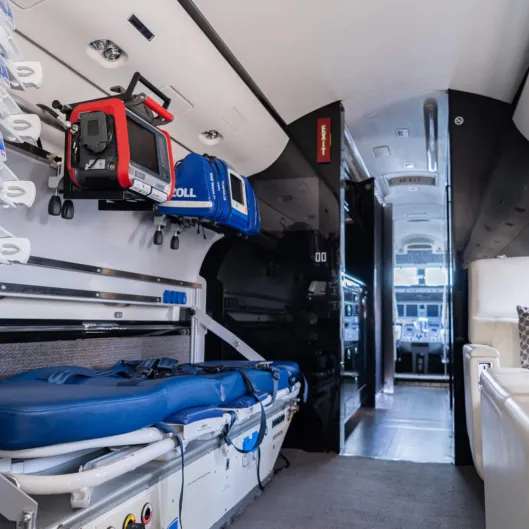
For guidance on when a medical companion on commercial flight is appropriate versus a dedicated air ambulance, see our detailed comparison in international patient travel: commercial flight or air ambulance.
Cost implications of medical companions
An acompañante de vuelo médico costs significantly less than an air ambulance charter. Air ambulance missions typically cost between 15,000 and 80,000 euros depending on distance and aircraft type, while medical escort on a commercial flight for the same route generally ranges from 2,500 to 8,000 euros, inclusive of companion flight, professional fees, and medical equipment.
Cost should not, however, be the primary deciding factor. The determining question is whether the patient is clinically suitable for commercial transport. If they are, cost savings are substantial and care quality remains high. If they are not, choosing commercial flight with an acompañante de vuelo médico instead of air ambulance introduces medical risk rather than reducing it.
Travel insurance coverage varies widely. Some policies cover medical escort services as part of repatriation benefits; others classify it as out-of-pocket expense. EMS provides a free quotation in under 30 minutes so you can confirm coverage with your specific insurer before making any decisions. For practical guidance on insurance claims, our article on whether travel insurance covers medical repatriation addresses common policy structures and exclusions.
When a medical companion is mandatory
Certain clinical situations make an acompañante de vuelo médico not merely recommended but required. Airlines will refuse boarding for medically complex passengers without an approved medical companion in the following circumstances:
- Patients requiring supplemental oxygen above standard airline provision, typically above 4 liters per minute
- Patients on intravenous medication drips that must continue during flight
- Patients with recent surgery carrying documented risk of post-operative complications such as pulmonary embolism or wound dehiscence
- Patients with neurological instability, including those recovering from seizures or acute stroke within 10 days of the event
- Patients unable to reliably communicate their own symptoms due to cognitive impairment or language barriers
Many families independently choose a medical companion even when not strictly mandatory. The certainty that a trained professional is monitoring your loved one for every hour of long-haul flight provides reassurance no checklist can replace. No matter where they are, EMS will safely transport your loved ones home.
You can also explore the full scope of medical escort services in our overview of what a medical escort is, who needs it, and how it works.
Frequently asked questions
What exactly does an acompañante de vuelo médico do during the flight?
An acompañante de vuelo médico monitors vital signs at regular intervals (typically every 30 to 60 minutes), administers medications according to physician protocol, manages in-flight symptoms such as pain or anxiety, communicates patient needs to cabin crew, and responds immediately to any deterioration. Upon arrival, the companion delivers a complete written clinical report to the receiving medical team, ensuring continuity of care. This is active clinical work, not passive supervision.
Is an acompañante de vuelo médico the same as an air ambulance?
No. An acompañante de vuelo médico travels on a standard commercial flight with the patient, while an air ambulance is a dedicated aircraft equipped with ICU-level life support systems. Medical companion services cost 2,500 to 8,000 euros and work well for stable patients cleared for commercial travel. Air ambulances cost 15,000 to 80,000 euros and are appropriate for critical or unstable patients requiring intensive monitoring and interventional capability.
How much does a medical flight companion service cost?
Medical flight companion services typically cost between 2,500 and 8,000 euros for commercial flight escort, depending on flight distance, patient clinical complexity, and equipment requirements. This represents a 75% to 90% savings compared to air ambulance charter for the same route. EMS provides a detailed, all-inclusive quotation within 30 minutes so you know exact costs before proceeding.
Can travel insurance pay for an acompañante de vuelo médico?
Many travel insurance policies include medical repatriation benefits that explicitly cover medical escort services, though terms vary by insurer and policy level. Most policies require pre-authorization before service begins. EMS works directly with insurers and assistance companies to confirm coverage eligibility, submit required documentation, and minimize out-of-pocket expenses for families during medical crises.
How quickly can a medical companion be arranged?
EMS can mobilize an acompañante de vuelo médico within 24 to 48 hours for most commercial flight routes. Airline approval via MEDIF submission may add 24 to 72 hours depending on the carrier and patient clinical profile. EMS begins coordination immediately upon first contact, ensuring no time is lost on administrative processes while the patient awaits transport.
Need medical transport?
Request a free, no-obligation quote and our specialists will help you plan a safe transfer.
Related blogs