Ambulance Jet: Your Guide to Safe Medical Repatriation and Flights
Returning Home Safely by Ambulance Jet: Your Guide to Medical Repatriation
It is every traveller’s worst nightmare, yet unfortunately a reality that happens every day: you are on holiday or travelling for business and suffer a serious accident or suddenly become critically ill. What began as a carefree trip turns into a complex medical situation far from home. Local healthcare may not meet the standards you are used to in the Netherlands or Belgium, hygiene may be substandard, or the language barrier makes communication with doctors impossible. You want just one thing: to get home as quickly as possible, to your own specialists, in your own language, and close to family. At that point, flying independently on a commercial airline is often medically irresponsible or simply impossible due to the severity of the condition.
That is where we come in. At EMS-Ambulance, we understand the immense stress, fear, and uncertainty this creates for both the patient and their family. We are here to take that burden completely off your shoulders. Whether it is a complex repatriation from a remote area in Asia or a short flight within Europe, our priority is to bring you or your loved one home safely, comfortably, and under the best possible medical supervision. We are not a call centre, but a team of dedicated experts available day and night. In this article, we explain exactly what an ambulance jet is, how repatriation works, and why our personal approach makes the difference in critical times.
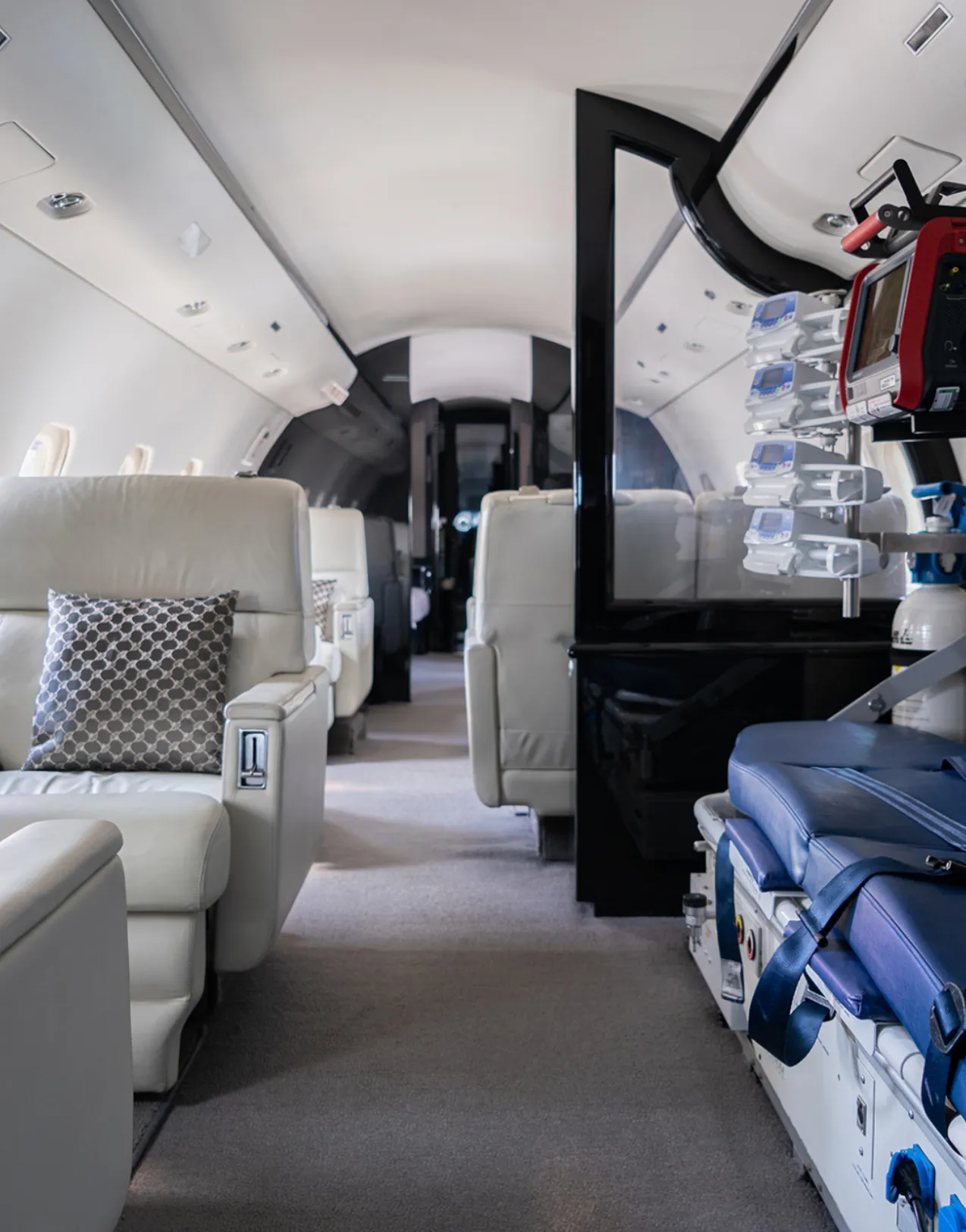
What exactly is an ambulance jet?
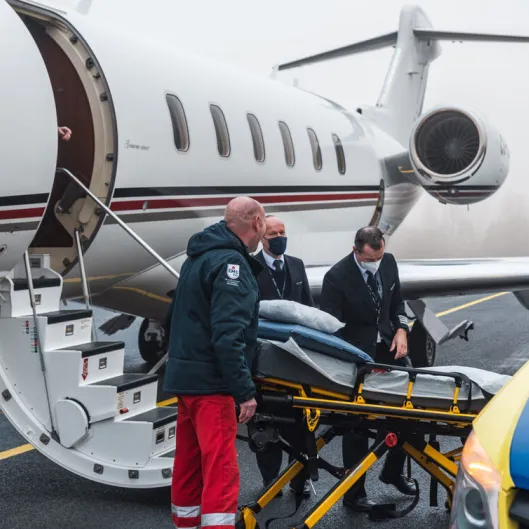
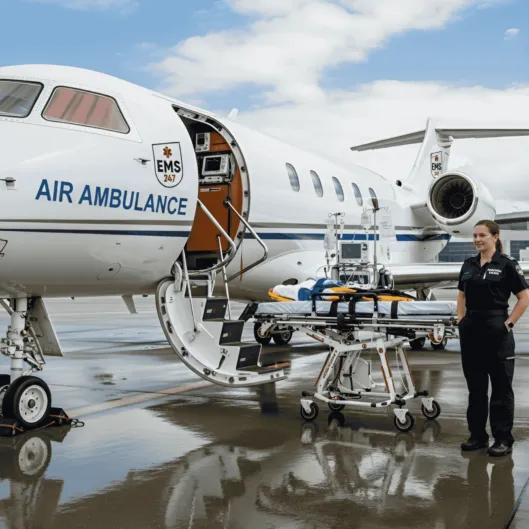
An ambulance jet (or jet air ambulance) is, simply put, a flying intensive care unit (ICU). It is essential to understand that this is not just an aircraft with a stretcher placed inside. Where a standard aircraft is configured to carry as many passengers and as much luggage as possible, a jet air ambulance is fully converted and permanently configured to provide the highest possible level of care for a single patient.
These aircraft, often Learjet, Bombardier Challenger, or Cessna Citation types, are equipped with advanced medical equipment comparable to what you would find in a modern intensive care unit. This includes state-of-the-art ventilators (such as the Hamilton T1), multi-parameter monitors for vital signs (such as the Corpuls 3), defibrillators, 12-lead ECG devices, blood gas analysers, and automated infusion pumps. In addition, there is an extensive range of emergency medication and condition-specific supplies on board. Thanks to this equipment, we can transport patients in an extremely critical condition, something that is absolutely impossible on regular scheduled flights.
The key difference compared with a commercial flight is not only the equipment, but also the conditions and flexibility. Air ambulance jets are compact, fast, and can often land at smaller airports closer to the hospital, significantly reducing overall transfer time. The jet also provides privacy and calm, away from the crowds, germs, and sensory overload of a busy passenger terminal.
The importance of “sea-level flight” and cabin pressure
One of the most important technical advantages of our air ambulance jets is the ability to control cabin pressure. In a normal commercial aircraft, the cabin pressure at cruising altitude is comparable to being at around 2,400 metres in the mountains. For healthy people this is not a problem, but for patients with certain conditions it can be life-threatening. Lower pressure causes gases in the body to expand and reduces oxygen saturation in the blood.
For patients with conditions such as a collapsed lung (pneumothorax), recent brain injury, bowel obstruction (ileus), or severe anaemia, normal cabin pressure can be fatal or seriously harmful. In these cases, we perform a so-called “sea-level flight”. The cabin pressure is kept artificially high (comparable to sea level) and the ambulance jet may fly at a slightly lower altitude. Our pilots and medical crew work closely together to ensure pressure changes remain minimal, allowing the patient to be transported safely and in a stable condition. This level of environmental control is unique to air ambulance operations.
When should you choose a jet air ambulance?
Not every medical repatriation requires a private aircraft. Sometimes medical assistance on a commercial flight (Medical Escort) is sufficient, which we discuss later. However, in critical or time-sensitive situations, a jet air ambulance is often the only safe and responsible option. We typically recommend a jet in the following situations:
- Intensive care patients: Patients who are intubated, require ventilation, or need continuous invasive monitoring. Their stability does not allow transfers through busy airports.
- Complex injuries and immobility: For example after a serious road traffic collision (polytrauma) or spinal injury (paraplegia) where the patient must remain completely horizontal and immobilised (vacuum mattress).
- Cardiac incidents: Patients who have recently had a heart attack, where the stress and pressure changes of a commercial flight could trigger another event.
- Infectious diseases: Situations requiring isolation to protect the patient or others (for example COVID-19, tuberculosis, or multi-resistant bacteria). We can install specialised isolation units (PMIU) in the aircraft.
- Psychiatric emergencies: When a patient may be a danger to themselves or others, a private jet provides a controlled and safe environment.
- Time pressure: When every minute matters and we cannot rely on fixed airline schedules or availability. An ambulance jet flies to our timetable.
Using air ambulance jets gives us the flexibility to fly when it is needed, often within 24 hours of the request.
Our medical crew: experts at altitude
Equipment is only as good as the people operating it. At EMS-Ambulance, we do not compromise on staffing. Aeromedical care is a specialty: the human body behaves differently at altitude, and procedures that are routine on the ground can become challenging in a small, moving space at 10 kilometres above the earth.
That is why our medical crew on board the ambulance jet typically consists of at least two specialists: a dedicated physician and a nurse. These are often anaesthetists, intensive care doctors, or trauma physicians, supported by ICU nurses or ambulance nurses/paramedics. All have received specific training in aviation medicine. This means they are trained to anticipate the effects of pressure, acceleration, and vibration on the patient. We also select our teams for empathy. Repatriation is emotionally demanding: our people are there not only to deliver medical care, but also to provide reassurance and clear explanations to the patient and any travelling family members.
How does medical repatriation work? Step by step
When you contact us, a structured process starts immediately. We believe in full support: you focus on your loved one, and we manage the logistics, technology, and administration. In practice, a repatriation looks like this:
- Immediate contact and intake (24/7): You call our emergency number or complete the form. You speak directly to an expert, not an automated menu. We listen and ask about medical status and location.
- Medical assessment and fit-to-fly: Our medical team contacts the treating doctors on site where possible. We request medical reports to determine fit-to-fly status. This is crucial for selecting the right ambulance jet and specialist crew (for example a paediatric specialist for children).
- Quote and planning: You receive a clear quote quickly, often within 30 to 60 minutes. At EMS-Ambulance, this is an all-inclusive price. We arrange permits, landing approvals, and crew logistics.
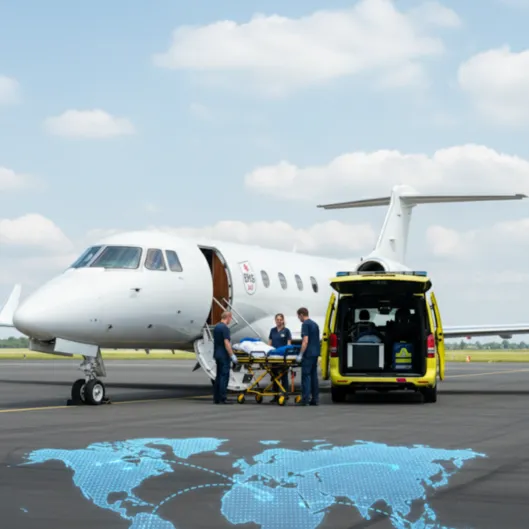
- Bed-to-bed service: Once approved, we activate the mission. We coordinate the local ambulance abroad to transfer the patient from the hospital bed to the aircraft. The patient transfers into our jet. After landing, an ambulance is ready for the final leg to the receiving hospital or home.
- Handover and aftercare: Our medical crew hands over the patient and documentation professionally to the receiving medical team. We do not leave until the patient is safely settled.

Case: complex repatriation from Thailand
To illustrate our approach, here is a recent anonymised case. Mr de Vries (58) suffered a severe brain haemorrhage while travelling in Thailand. After initial treatment in Bangkok, his family wanted to bring him to the Netherlands for further rehabilitation. The distance was considerable (over 9,000 km) and he still required partial ventilatory support.
EMS-Ambulance acted immediately. Because a direct flight with a smaller jet would require multiple stops, we deployed a long-range ambulance jet, a Bombardier Challenger, capable of completing the distance with just one refuelling stop. Due to the brain haemorrhage, a strict sea-level protocol was necessary to avoid increases in intracranial pressure. Our team, consisting of a neurologist and an ICU nurse, flew to Bangkok, stabilised Mr de Vries for transport, and provided continuous care throughout the 12-hour mission. On arrival in Rotterdam, an ambulance was waiting. The family received updates throughout the flight via satellite communication. This is what we stand for: turning complex logistics into a safe journey.
Quality and safety: TUV and ISO 9001 certified
In aviation and medicine, protocols are vital. You need to be certain that the provider you choose meets the strictest international requirements. Anyone can build a website, but not everyone can safely transport an ICU patient. EMS-Ambulance is proud to be TUV ISO 9001 certified.
This is not an empty logo on a website. It is a concrete guarantee that our processes are audited externally every year. It means everything, from aircraft maintenance and the hygiene of medical equipment to administrative handling and complaints procedures, meets global quality standards. While some providers (brokers) only arrange transport without controlling quality, we maintain direct oversight of the resources and standards used. Your safety is not negotiable.
Alternatives: medical escort on a commercial flight or a private jet
Although an ambulance jet is the most comprehensive solution, we always look for the most appropriate option based on medical condition and budget. Sometimes a patient is stable enough for alternatives.
Medical Escort: For patients who can sit or lie stably, a doctor or nurse can accompany them on a commercial flight. This can be in Business Class (for comfort and the ability to recline) or via a stretcher service. With a stretcher, a row of seats (often at the rear of economy) is removed and replaced by a medical bed, screened with curtains. We arrange tickets, airline medical clearances, and oxygen on board.
Private jet with medical escort: A practical middle option. For patients who value privacy, comfort, and speed but do not require ventilation or full ICU-level care, we can arrange medical escort on a standard private jet. This offers the speed and flexibility of a jet air ambulance in a setting that feels more like private travel and less like a hospital. It is often more cost-effective than a fully equipped ambulance jet, as it allows us to use a wider range of smaller aircraft.
Costs and insurance
A common question concerns cost. The price of an ambulance jet depends on many factors: aircraft type, flight distance, required medical crew, landing fees, and urgency. Because it is tailored to the mission, we cannot provide a fixed price list, but we can calculate an exact price quickly.
In many cases, repatriation costs are covered by travel insurance under medical repatriation or emergency assistance. It is important to review your policy. If you are not covered or your claim is declined, EMS-Ambulance can also support self-paying clients. We can liaise with your insurer to explain medical necessity, which sometimes helps secure reimbursement. Our quotes are transparent: no hidden fuel surcharges and no unexpected ground ambulance costs afterwards. What we agree is what you pay.
Why choose EMS-Ambulance?
The repatriation market includes large international providers such as AirMed or Medical Air Service. What makes us different is our approach. Large organisations can feel slow and bureaucratic, with case numbers taking priority and a different person on the phone each time. At EMS-Ambulance, we combine global operational capability with the personal attention of a boutique provider.
Our strengths:
- Personal contact: One dedicated point of contact who knows your case. We are reachable 24/7 and communicate clearly.
- Speed: A quote within 30 to 60 minutes, and if necessary we can fly the same day.
- Transparency: All-inclusive pricing with no surprises.
- Bed-to-bed service: We arrange ground transport as well, including coordination abroad.
- Experience: Extensive experience with complex global cases, from conflict zones to remote islands.
Frequently asked questions about air ambulances and repatriation
How do I request an ambulance jet quickly?
In emergencies, every minute counts. Call our emergency number (available on ems-ambulance.com) or complete the contact form. We are available 24 hours a day, 7 days a week. Have the patient’s location and, if possible, the treating doctor’s contact details ready. We take it from there.
What are the steps in medical repatriation?
- Intake and advice,
- Medical evaluation (fit-to-fly check),
- Quote and flight planning,
- Ground transfer to the airport,
- Medical flight,
- Ground transfer and handover.
What is an ambulance jet?
An ambulance jet is an aircraft converted into a mobile intensive care unit. It carries specialised medical equipment and medication to transport patients safely over long distances when commercial travel is not possible.
What is medical repatriation?
Medical repatriation is the organised return of a patient to their home country (or a country with more suitable care) under medical supervision. The goal is better care, recovery in familiar surroundings, and being close to family.
Who accompanies a medical repatriation?
This depends on the patient’s condition. On an ambulance jet, the team typically includes a doctor and a nurse. For stable patients on commercial flights, a single nurse or doctor may be sufficient as a Medical Escort. We match the team to the patient’s condition.
Is the medical staff highly qualified?
Yes. We work only with registered, experienced specialists. Our doctors and nurses have extensive backgrounds in acute care (ICU, Emergency Medicine, Anaesthetics) and additional training in aviation medicine.
Are air ambulance services ISO certified?
Yes. EMS-Ambulance is TUV ISO 9001 certified, confirming internationally recognised quality management and strict safety procedures.
Do you provide worldwide bed-to-bed service?
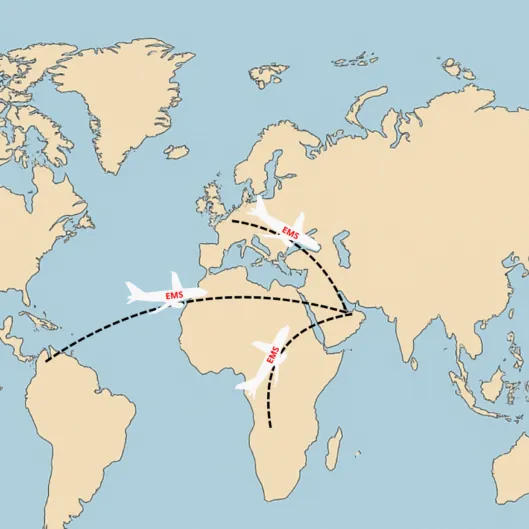
Yes. We do not limit ourselves to the flight or to Europe. We collect the patient from their hospital bed abroad and remain with them until they are safely in the receiving hospital bed, anywhere in the world.
Can I book medical escort for a private jet?
Yes. If the medical condition allows (no ICU-level care required), we can provide a medical team (doctor or nurse) to escort a patient on a standard private jet. This can be a comfortable option for fractures or mild conditions where privacy is preferred.
Do not take risks, choose certainty
Your health, or the health of your loved one, leaves no room for compromise. When illness or injury strikes abroad, you want a partner who acts decisively, communicates with empathy, and delivers high-level medical care. With our fleet of air ambulance jets and our dedicated medical teams, we are ready to bring you home safely, wherever you are in the world.
Do you need help now, or would you like free advice about repatriation options? Do not wait. Contact EMS-Ambulance. We listen, advise, and bring you home safely.
Related blogs